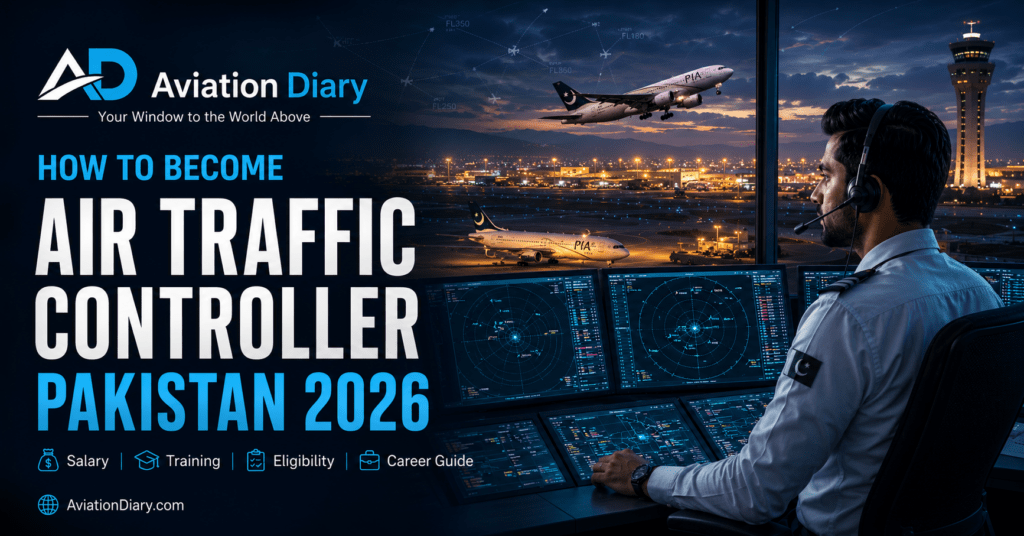

Becoming an air traffic controller in Pakistan is one of the smartest career moves in aviation today. You don’t fly the aircraft—you keep every aircraft in Pakistani airspace safe, separated, and moving. If you have sharp decision-making under pressure, strong spatial awareness, and a passion for aviation without the cockpit, ATC is your path.
This guide covers everything — who hires air traffic controllers in Pakistan, what qualifications you need, how the training works, what you earn, and exactly how to get started in 2026.
“Pilots looking to join Pakistan’s growing airline sector can explore current openings, including Airblue Rated Captain positions now available.”
What Does an Air Traffic Controller in Pakistan Actually Do?
An air traffic controller in Pakistan manages the movement of aircraft in assigned airspace or at an airport. The role splits into three specializations:
Tower Control manages aircraft on the runway and in the immediate vicinity of the airport. Every takeoff and landing clearance at Jinnah International, Allama Iqbal, or Islamabad International comes from a tower controller.
Approach Control — manages aircraft arriving and departing within roughly 50–100 nautical miles of an airport. Guides pilots through the critical transition between cruise and landing.
Area/En route Control—manages aircraft in cruise flight through Pakistan’s upper airspace. Pakistan’s airspace is one of the busiest in the region—a significant portion of Gulf-to-Europe traffic transits overhead daily.
All three require a PCAA-issued ATC license. The license type corresponds to the specialization.
Who Hires Air Traffic Controllers in Pakistan?
There are two primary employers for an air traffic controller in Pakistan:
Pakistan Civil Aviation Authority (PCAA) The primary ATC employer in Pakistan. PCAA is the regulatory body that oversees aviation operations throughout the country, including air traffic control, ensuring Pakistan’s airspace remains safe and aligned with international standards. PCAA operates the major area control centers and approach facilities across the country. PCAA Jobs 2026
Pakistan Airports Authority (PAA) recruits for air traffic control, communication operations, and airport services roles across its nationwide network of airports. PAA handles tower control at several airports across Pakistan. PAA Jobs 2026
Both organizations announce vacancies through official channels—pcaa.gov.pk and paa.gov.pk. Recruitment is competitive and strictly merit-based.
Minimum Qualifications for Air Traffic Controller Pakistan
Educational requirement:
- F.Sc (Pre-Engineering or with Physics and Mathematics) with a minimum of 60% marks, OR
- Bachelor’s degree in Engineering, Electronics, Telecommunications, or a related field
Physics and Mathematics are non-negotiable. Every ATC training program — internationally and in Pakistan — requires a strong foundation in both subjects.
Age: Typically 18–28 years for entry-level positions. Age relaxation applies for government quota candidates.
Medical fitness: ATC candidates must pass a Class 3 Medical examination issued by a PCAA-approved medical examiner. Key requirements include normal vision (correctable is acceptable for ATC, unlike for pilots), normal hearing, and no neurological conditions. Less stringent than a pilot medical but still a serious filter.
Nationality: Pakistani citizen only.
Air Traffic Controller Pakistan Training Pipeline
Once selected, candidates go through a structured training program. Pakistan’s ATC training follows ICAO standards—the same framework used globally.
Stage 1 — Initial Training Ground school covering aviation theory, meteorology, navigation, airspace structure, ICAO procedures, and communication phraseology. Conducted at PCAA’s training facilities. Duration varies by cohort but typically runs several months.
Stage 2—Simulator Training Radar and procedural simulation. Candidates practice handling multiple aircraft in controlled scenarios before touching live traffic. This is where most candidates discover the real difficulty — managing 8–12 aircraft simultaneously under time pressure.
Stage 3 — On-the-Job Training (OJT) Assigned to an operational ATC unit under supervision of a licensed controller. Works live traffic with a trainer monitoring every transmission. OJT is the longest phase and the most critical phase—this is where the license is earned or lost.
Stage 4 — PCAA License Issuance Upon successful completion of OJT and written examinations, PCAA issues the ATC license for the relevant rating—Aerodrome, Approach, or Area. The license must be renewed periodically with continued competency checks.
Air Traffic Controller Pakistan Salary — Honest Numbers
This is what every candidate actually wants to know before committing to this career path.
An air traffic controller in Pakistan earns between PKR 95,130 and PKR 241,318 per month at the entry level. After 5 years of service, this rises to between PKR 105,260 and PKR 249,790 per month.
At senior and management levels, an air traffic controller in Pakistan with a bachelor’s degree earns an average of PKR 964,000 per month, rising to PKR 1,621,400 for those with a master’s degree.
Beyond base salary, PCAA employees receive housing allowance, medical coverage for self and family, annual leave, and pension benefits. Senior ATCs with international ratings—particularly those certified for oceanic or RVSM airspace—command significantly higher compensation.
Career Progression for an Air Traffic Controller in Pakistan
ATC is not a flat career. The progression path is structured and clear:
Junior ATC Officer—entry level, working under supervision with limited ratings
ATC Officer — full license holder, working independently on assigned positions
Senior ATC Officer—experienced controller, may begin supervising OJT candidates
Watch Supervisor—manages an ATC shift, responsible for all traffic in the sector during their watch
Unit Manager / ATCO-in-Charge — manages an entire ATC facility
Senior Management (PCAA) — Director-level positions overseeing ATC operations nationally
Controllers who obtain additional ICAO ratings—particularly Instrument Rating and Radar Rating—accelerate through this path faster and earn significantly more.
Air Traffic Controller Pakistan vs. Pilot: Which Career Is Right for You?
This is the most common question from aviation students in Pakistan choosing between the two paths.
| Factor | ATC | Pilot (CPL) |
|---|---|---|
| Initial cost | Low — PCAA funds training on selection | High — PKR 40–80 lakh for CPL |
| Training bond | Yes—typically 5 years | No (private CPL) |
| Medical standard | Class 3 (less stringent) | Class 1 (strict) |
| Shift work | Yes—24/7 operations | Yes—irregular hours |
| Career ceiling | Senior management, ICAO roles | Captain, then simulator/management |
| International mobility | Strong—ICAO-rated ATCs are globally hireable | Very strong |
| Stress level | Extreme during peak traffic | Extreme during operations |
If the cost of a pilot license is the barrier, becoming an air traffic controller in Pakistan is the smarter entry into the industry. PCAA funds your training—you pay nothing upfront.
How to Apply for Air Traffic Controller Pakistan Jobs
- Monitor pcaa.gov.pk and paa.gov.pk for ATC recruitment announcements—both organizations recruit periodically, not on a fixed annual cycle
- Ensure your F.Sc or degree result meets the minimum 60% threshold before applying
- Book a Class 3 Medical with a PCAA-approved AME to confirm medical eligibility before investing time in the application
- Apply online through the official portal when recruitment opens—do not use third-party agents
- Prepare for the written test covering Physics, Mathematics, English, and general aviation knowledge
- If shortlisted, prepare for a psychometric and aptitude assessment—ATC selection includes spatial reasoning and multi-tasking tests, not just academics
- Subscribe to Aviation Diary’s newsletter—we publish PCAA and PAA recruitment announcements the day they go live. PAF Medical Branch Jobs 2026
The One Thing Most Air Traffic Controller Candidates Miss
The psychometric and aptitude assessment. Most candidates prepare for the written test and ignore the cognitive screening entirely. PCAA’s ATC selection — like most international ATC programs — includes tests specifically designed to assess your ability to track multiple moving objects, process information under time pressure, and make fast decisions with incomplete data. You cannot cram for these overnight. Practice using free ATC aptitude simulation tools available online and start well before the written exam.

Your Window to the World Above!