Every week at AviationDiary, we receive messages from students, parents, and young professionals asking the same thing: “How to Become a Pilot in Pakistan?”
Not the brochure version. Not the YouTube highlights. The real, honest, step-by-step process — costs included, timeline included, and hard truths included.
This is that guide.
We have covered everything from the PCAA eligibility requirements to choosing the right flying school, from the SPL all the way to your first airline interview. Whether you are a student in Karachi fresh out of FSc, a working professional in Lahore wondering if it is too late, or a parent in Islamabad trying to understand what your child is getting into—this is the most comprehensive guide on how to become a pilot in Pakistan you will find anywhere.
Let us get into it.
How to Become a Pilot in Pakistan: Start With the Big Picture
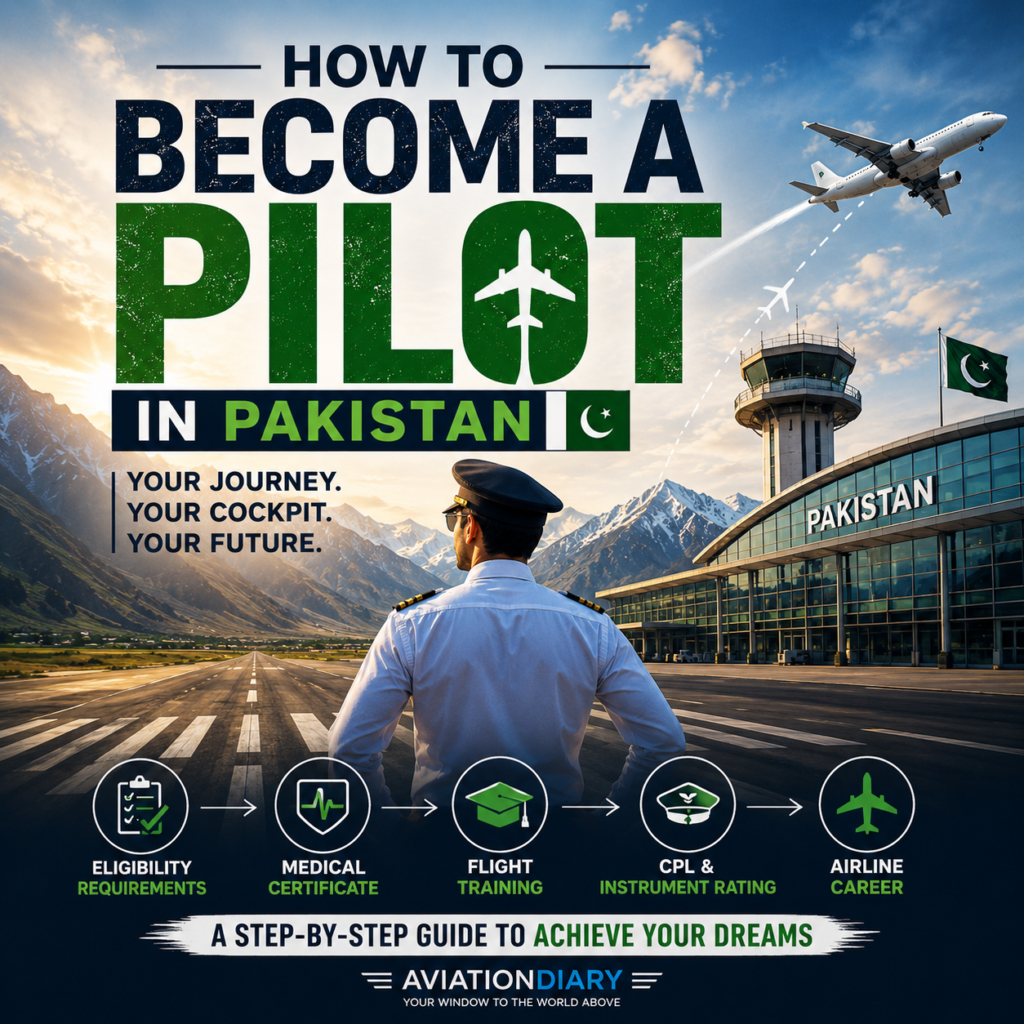
Before anything else, understand the journey. Becoming a pilot in Pakistan is not a single event — it is a multi-year process with distinct stages, each with its own requirements, costs, and exams. Here is the full picture at a glance:
- Stage 1: Meet basic eligibility requirements
- Stage 2: Obtain PCAA Class 1 Medical Certificate
- Stage 3: Enrol in a PCAA-approved flying school
- Stage 4: Earn your Student Pilot Licence (SPL)
- Stage 5: Complete Private Pilot Licence (PPL) training
- Stage 6: Complete Commercial Pilot Licence (CPL) + Instrument Rating (IR)
- Stage 7: Get hired by a Pakistani airline — PIA, Airblue, Fly Jinnah, Serene Air, or AirSial
Each stage builds on the last. You cannot skip steps. But the path is clear — and thousands of Pakistani pilots have walked it before you.
Step 1: Know the Basic of How to Become a Pilot in Pakistan
If you are serious about how to become a pilot in Pakistan, the first thing you need to do is check whether you meet the fundamental requirements set by the Pakistan Civil Aviation Authority (PCAA).
Age
- You can apply for a Student Pilot Licence (SPL) from the age of 16
- You must be at least 17 to fly solo
- You must be at least 18 to begin CPL training
- Most airlines set a maximum cadet pilot age of 35 at application
Education
- SPL/PPL: Minimum Matriculation (Grade 10)
- CPL: Minimum Intermediate (Grade 12) — science subjects (Physics and Mathematics) are strongly preferred, though not always mandatory
- A Bachelor’s degree gives you a competitive advantage at airline interviews and is preferred by Airblue for cadet pilots
Nationality
You must generally be a Pakistani citizen to obtain a PCAA pilot licence. Security clearance is required as part of the licensing process.
English Language
You must be able to speak, read, write, and comprehend English to a functional standard. PCAA and all Pakistani airlines require ICAO English Language Proficiency (ELP) at Level 4 or above for commercial operations.
The Honest Reality Check
If you wear glasses, do not panic — corrected vision to certain standards is acceptable for Class 1 medical. What is not acceptable: certain heart conditions, significant neurological history, or vision that cannot be corrected to the standard. Get your medical check done early. Do not invest years of planning only to discover a medical disqualifier you could have identified on day one.
Step 2: Get Your PCAA Class 1 Medical Certificate — Do This First
This is the single most important first step for anyone wondering how to become a pilot in Pakistan, and it is the one most people skip until too late.
The PCAA Civil Aviation Medical Board (CAMB) conducts medical examinations for pilot candidates. The Class 1 medical is required for CPL training and commercial flying. It covers:
- Vision tests (distance, near vision, colour vision, depth perception)
- Hearing tests
- Cardiovascular assessment (ECG, blood pressure)
- Neurological assessment
- ENT examination
- Blood and urine tests
- General physical examination
Where to get it: PCAA Civil Aviation Medical Board, with examination centres in Karachi, Lahore, and Islamabad.
Why do this first: If you have a condition that disqualifies you from the Class 1 medical, you need to know before you spend Rs 5–10 million on flying training. No medical clearance means no CPL. It is that simple.
Cost: PCAA medical fees vary; check the current fee schedule on the PCAA website, as fees are updated periodically.
“For those already holding an ATPL, Airblue is currently hiring Rated Captains for its expanding A320 fleet.“
Step 3: Choose the Right PCAA-Approved Flying School in Pakistan
Choosing the right flying school is one of the most important decisions on your path to becoming a pilot in Pakistan. This is the aviation equivalent of choosing your university — it will shape the quality of your training, your network, and ultimately your career.
What to Look For
PCAA Approval: The school must be an Approved Training Organisation (ATO) under PCAA. Training at an unapproved school means your hours will not count toward your licence. Verify approval status directly with PCAA.
Aircraft Fleet: Modern, well-maintained training aircraft matter. Most schools use Cessna 150, 152, or 172 aircraft – the industry standard for ab-initio pilot training worldwide.
Instructor Quality: Ask about your instructors’ experience, their flying hours, and how long they have been instructing. Experienced instructors build better pilots.
Batch Size: Smaller batch sizes mean more flying time per student and faster completion. Ask how many students share each aircraft.
Completion Rate: Ask directly — what percentage of students who start the CPL programme actually complete it? Any school worth attending will answer this honestly.
Major PCAA-Approved Flying Schools in Pakistan
Karachi Aero Club (Karachi) The subcontinent’s oldest flying institution, operating from Jinnah International Airport. Highly respected reputation, Cessna fleet, detailed ground school programme. The integrated CPL/IR course is one of the most established in Pakistan. Course start dates are published for all of 2026 on their website.
Rawalpindi Flying Club One of the most prominent flying clubs in Pakistan, located in Islamabad. Long track record of producing commercial pilots who have gone on to careers at PIA and other carriers.
Air Eagle Aviation Academy (Lahore) A project of the Shaheen Foundation, PAF. Located at Allama Iqbal International Airport, Lahore. Well-equipped campus with modern facilities and a structured CPL programme.
Airborne Aviation (Various Locations) offers PPL and CPL programmes. PPL training comprises 40 hours of flight training with an 8-month duration from SPL issuance.
Sky Wings Aviation (Karachi) offers both integrated and modular CPL training. Modular training gives flexibility for students who need to work alongside their studies.
Other Regional Clubs: Pakistan Flying Club (Lahore), Punjab Flying Club, Margalla Flying Club (Islamabad), Peshawar Flying Club, Multan Flying Club, and Sialkot Flying Club all offer PPL and in some cases CPL pipeline training. Contact directly for current availability.
Integrated vs Modular — Which Should You Choose?
Integrated Course: All training done in one continuous sequence from zero to CPL. Fixed schedule, faster completion (typically 18–24 months), less flexibility. Better for students who can commit full-time.
Modular Course: PPL and CPL done in separate stages with no fixed timeline. More flexible — you can work or study alongside training. Can take longer. Better for working professionals or those with other commitments.
Step 4: Earn Your Student Pilot Licence (SPL) — Your First Wings
The SPL is your entry point. Once enrolled at a PCAA-approved flying school, the school will guide you through the SPL application process.
The SPL allows you to begin flight training with an instructor. You cannot fly solo on an SPL — that comes with the PPL stage. But the SPL is the official start of your aviation life.
Requirements for SPL:
- Minimum age 16
- Class 2 medical certificate (minimum for SPL)
- Enrolment in a PCAA-approved flying school
- Basic ground school commencement
Think of the SPL as your aviation driving learner’s permit. It is the starting point, not the destination.
Step 5: Complete Your Private Pilot Licence (PPL) Training
The PPL is where you learn to actually fly. It is one of the most rewarding phases of pilot training — the moment you lift off solo for the first time is something no pilot ever forgets.
PPL Requirements in Pakistan
Minimum Flight Hours: 40 hours total flight time, including the following:
- Dual instruction time (with an instructor)
- Solo flight time
- Solo cross-country flying
- Night flying
- Instrument flying (basic)
Ground Exams: Student pilots must pass 7 PCAA written examinations for the PPL. Subjects include:
- Air Law
- Air Navigation
- Meteorology
- Aircraft General Knowledge
- Flight Performance and Planning
- Human Performance and Limitations
- Principles of Flight
PPL Skill Test: A flight test with a PCAA examiner to demonstrate practical flying competence.
Duration: Approximately 8 months from SPL issuance for a dedicated full-time student.
Cost: PPL training costs approximately PKR 1.5–2.5 million depending on the school and the number of hours required.
The PPL allows you to fly as pilot-in-command of small aircraft for personal, non-commercial purposes. It is not enough to fly for an airline — that requires the CPL. But the PPL is where the foundation of your flying skill is built, and it is where you discover whether you have the aptitude and passion to go further.
Step 6: How to Become a Pilot in Pakistan at the Commercial Level — The CPL + Instrument Rating
This is the core qualification. The Commercial Pilot Licence (CPL) with Instrument Rating (IR) is what allows you to be paid to fly — and what all Pakistani airlines require as a minimum for first officer positions.
CPL Requirements in Pakistan
Minimum Age: 18 years Minimum Total Hours: 200 hours (150 hours after the PPL if doing modular training) Must hold: a valid PPL, valid Class 1 medical, and a valid SPL with FRTOL (Flight Radio Telephone Operator Licence)
Flight Training Components:
- Solo cross-country flying
- Multi-engine aircraft training (required for most airlines)
- Instrument flying (flying solely by reference to cockpit instruments)
- Night flying
- Advanced navigation
CPL Ground Examinations: 6 PCAWritten examinations, including:
- Air Law (advanced)
- Air Navigation (advanced)
- Meteorology (advanced)
- Aircraft General Knowledge (technical)
- Flight Performance and Planning
- Human Performance and Limitations
Instrument Rating (IR): The IR is a separate rating added to the CPL that certifies you to fly in cloud and poor visibility using instruments alone. It is mandatory for airline operations and should be completed alongside or immediately after your CPL.
Duration: An integrated CPL/IR from scratch typically takes 18–24 months for a dedicated student. Modular programmes have no fixed timeline.
CPL Cost: This is the big number. Full CPL training in Pakistan costs approximately PKR 4.5–6.5 million depending on the school, aircraft type, and total hours flown. The Karachi Aero Club’s Professional Pilot Course (PPL+CPL+IR) was priced at approximately PKR 3.45 million for 190 hours — though this does not include CAA exam fees, medical fees, or licensing fees.
The ATPL — Your Long-Term Goal
The Airline Transport Pilot Licence (ATPL) is the highest pilot qualification and is required to serve as captain of a commercial airline aircraft. You cannot apply for a full ATPL until you have accumulated 1,500 total flying hours. Most pilots spend years as a first officer building hours toward the ATPL – it is a long-term goal, not an immediate one.
Step 7: Get Hired — How to Become a Pilot in Pakistan’s Airlines
You have your CPL. You have your IR. You have 200+ hours in your logbook. Now what?
This is the stage that most pilot training guides in Pakistan completely skip, and it is the stage that matters most to your actual career.
What Pakistani Airlines Are Looking For
The PIA Cadet Pilot Programme, Pakistan International Airlines, runs a cadet pilot scheme that is arguably the most accessible route into commercial aviation for newly licensed pilots in Pakistan. Requirements:
- Valid CPL/IR from PCAA
- ICAO ELP Level 4 or above
- Minimum 200 flying hours
- Minimum Intermediate (1st Division/B Grade) or equivalent
- Maximum age 35 at application
- Valid Class 1 medical
Successful candidates undergo a computer-based test (CBT) conducted by an independent testing agency before proceeding to further selection stages.
Airblue Cadet Pilot Programme: Airblue has recruited cadet pilots with as few as 200 hours, making it another accessible first posting for newly licensed pilots. Requirements:
- Valid CPL or ATPL
- Minimum 200 total flying hours
- Valid Class 1 medical from CAA Pakistan
- Bachelor’s degree preferred
- Minimum age 21
Fly Jinnah Fly Jinnah operates an A320 fleet and requires more experience for direct entry first officers — typically 3,750+ hours on A320 family for upgrade programmes. For new entrants, watch their career portal at careers. airarabia.com/flyjinnah for cadet programmes when announced.
SereneAir and AirSial both periodically advertise for First Officers. Requirements are broadly similar to PIA and Airblue cadet standards. AirSial in particular has been expanding rapidly — as we covered in our post on [AirSial Skardu Flight 2026: Islamabad to Skardu Route Launched] on Aviation Diary, the airline is aggressively growing its network, which means growing its pilot requirements too.
The Selection Process — What to Expect
Most Pakistani airline pilot selection processes follow this sequence:
- Application and document screening — CV, licences, logbook, medical, academic certificates
- Computer-Based Test (CBT) — technical knowledge, aptitude, English
- Simulator Assessment — basic handling, procedural knowledge, crew resource management
- Medical Examination — Class 1 revalidation by airline medical team
- HR Interview — motivation, situational judgment, communication
- Type Rating Training — if selected, you undergo training on the airline’s aircraft type (A320, ATR, etc.) — this may be funded by the airline or bonded to you
The Hours Gap — The Biggest Challenge for New Pilots
Here is the honest truth that nobody in the Pakistani aviation industry likes to talk about publicly: the jump from 200 hours (your CPL minimum) to 1,500+ hours (when you become highly employable across multiple carriers) is the hardest part of a pilot’s career.
Most newly licensed Pakistani pilots enter the industry as flight instructors at flying schools, building hours while teaching others. Instructing is excellent for developing flying skills and some of the best airline pilots in Pakistan spent their early years as instructors. Others fly charter, cargo, or aerial survey operations to build hours.
The timeline from CPL to a First Officer seat at a major airline varies — some pilots do it in 1–2 years, others take 3–5 years. Patience, continuous learning, and keeping your medical and currency current during this period are critical.
How to Become a Pilot in Pakistan: The PAF Route
For completeness, the Pakistan Air Force route deserves a separate mention. The PAF offers pilot training to candidates who join through the General Duty Pilot (GDP) branch. PAF pilots fly high-performance military jets, transport aircraft, and helicopters on behalf of the Pakistan state.
The PAF route is separate from civilian aviation. You do not obtain a PCAA licence through PAF training — you obtain a PAF Flying Badge. However, PAF pilots who complete their service obligation (typically 7–10 years) and transition to civilian aviation bring thousands of hours of flying experience and are often fast-tracked to Captain positions at Pakistani airlines.
How Long Does It Take to Become a Pilot in Pakistan?
One of the most common questions we receive on Aviation Diary. Here is a realistic timeline:
| Stage | Estimated Duration |
|---|---|
| SPL + Ground School | 1–2 months |
| PPL Training | 6–9 months |
| CPL + IR Training | 12–18 months |
| Total to CPL: | 18–30 months |
| Building hours to airline minimums | 1–4 years |
| Type Rating + First Airline Job | 3–6 months |
| Total from zero to First Officer seat: | 3–6 years realistically |
The brochures say 18 months. The reality, for most Pakistani pilots, is closer to 3–4 years from starting training to a First Officer seat. This is not a failure of the system — it is the nature of a career that requires genuine experience before you are trusted with a commercial aircraft full of passengers.
The Honest Cost of Becoming a Pilot in Pakistan
Let us put all the costs together in one place:
| Item | Estimated Cost (PKR) |
|---|---|
| PCAA Class 1 Medical | Rs 15,000 – Rs 30,000 |
| SPL Enrolment + Ground School | Included in flying school fees |
| PPL Training (40 hours) | Rs 1,500,000 – Rs 2,500,000 |
| CPL Training (additional 150+ hours) | Rs 3,000,000 – Rs 4,500,000 |
| Instrument Rating (IR) | Rs 500,000 – Rs 1,000,000 |
| PCAA Exam Fees (all subjects) | Rs 50,000 – Rs 100,000 |
| License Fees | Rs 20,000 – Rs 50,000 |
| Books, headset, equipment | Rs 50,000 – Rs 150,000 |
| Total Estimated Range | Rs 5,000,000 – Rs 8,500,000 |
This is a significant investment. It requires serious financial planning — either family funding, a bank education loan, or in some cases, an airline-sponsored cadet bond.
The return on that investment, once you reach senior First Officer or Captain level, is substantial — as we detailed in our post on [Pilot Salary in Pakistan 2025] on AviationDiary. But the early years require patience.
5 Things Nobody Tells You About Becoming a Pilot in Pakistan
1. The medical check can end it before it starts. Get your PCAA Class 1 medical before spending a rupee on training. Colour blindness, certain cardiac conditions, and uncorrectable vision are disqualifiers. Know your status early.
2. Flying in Pakistan’s north requires special authorisation. If you dream of flying into places like Gilgit, Skardu, or Chitral — Pakistan’s most demanding airports — know that these routes require specific route training and authorisation beyond your basic CPL. We covered exactly what makes these airports so technically demanding in our post on [The 3 Most Dangerous Airports in Pakistan for Pilots] on AviationDiary.
3. Weather delays your training more than you expect. Pakistan’s summer heat and monsoon season affect flying hours significantly. Training during peak summer in Karachi or during monsoon months means more cancelled flying days than your school’s schedule assumes.
4. Your English matters as much as your flying. ICAO ELP Level 4 is the minimum for a commercial license. Airlines want Level 5 or 6. Weak English will cost you opportunities regardless of your flying skill.
5. The aviation community in Pakistan is smaller than you think. Your reputation starts forming the day you enrol. How you behave at flying school, how you treat ground staff, how you perform in your early flights — people remember all of it. The aviation industry in Pakistan is a network, and that network will define your career as much as your logbook.
Frequently Asked Questions: How to Become a Pilot in Pakistan
Can I become a pilot in Pakistan after FSC (pre-medical)? Yes, intermediate is the minimum educational requirement for CPL training. Pre-engineering (physics and mathematics) is preferred over pre-medical, but many pilots have entered the field with pre-medical backgrounds. If physics is weak, invest time in self-study before starting ground school.
Can a girl become a pilot in Pakistan? Absolutely. Pakistan has female pilots at PIA, Airblue, and other carriers. All requirements – medical, educational, and flight hours – are identical regardless of gender. The challenges are real, but the opportunities are the same.
Can I do pilot training abroad and get a PCAA licence? Yes. Many Pakistani pilots train abroad (the UK, USA, Australia, the Philippines, and Malaysia are common choices) and then convert their foreign licence to a PCAA CPL. The conversion process involves PCAA ground examinations and a skill test. Some pilots choose this route for lower costs or better training infrastructure. Weigh total costs carefully — conversion fees, travel, living abroad, and credential verification add up.
Is it too late to become a pilot at 28 or 30? Not at all. PIA accepts cadet pilot applications up to age 35. Many Pakistani pilots started their CPL training in their late twenties and went on to successful airline careers. The key is that you complete training and accumulate hours before age-based airline cutoffs become a factor.
What is the difference between PPL, CPL, and ATPL? PPL (Private Pilot Licence) allows you to fly for personal use — you cannot be paid. A CPL (Commercial Pilot Licence) allows you to be paid to fly — this is what airlines require for First Officers. ATPL (Airline Transport Pilot Licence) is required to serve as Captain of a commercial airline. You need 1,500 hours minimum to apply for an ATPL in Pakistan.
Which is the best flying school in Pakistan? The Karachi Aero Club is the oldest and one of the most respected. Rawalpindi Flying Club and Air Eagle in Lahore are also well-regarded. The “best” school depends on your location, budget, batch size preferences, and aircraft availability. Visit in person, speak to current students, and ask to see the fleet before enrolling.
How much does it cost to become a pilot in Pakistan in 2026? The full journey from zero to CPL costs approximately Rs 5 to 8.5 million depending on the school, aircraft type, and total hours flown. This does not include living costs during training.
Final Word
Learning how to become a pilot in Pakistan is the easy part. Actually doing it — committing to years of study, flying, exams, financial pressure, and patience during the hours-building phase — is where most people separate from the dream.
But for those who do commit? The career is extraordinary. From the flight deck of an ATR threading into Gilgit Valley, to a Boeing 777 lifting off from Islamabad bound for London, to a Karachi–Dubai sector at 35,000 feet as the sun rises over the Gulf – this is a career that rewards dedication with experiences most people only dream of.
At AviationDiary, we are here to give you the honest picture at every stage of that journey.
Fly safe — and fly far.