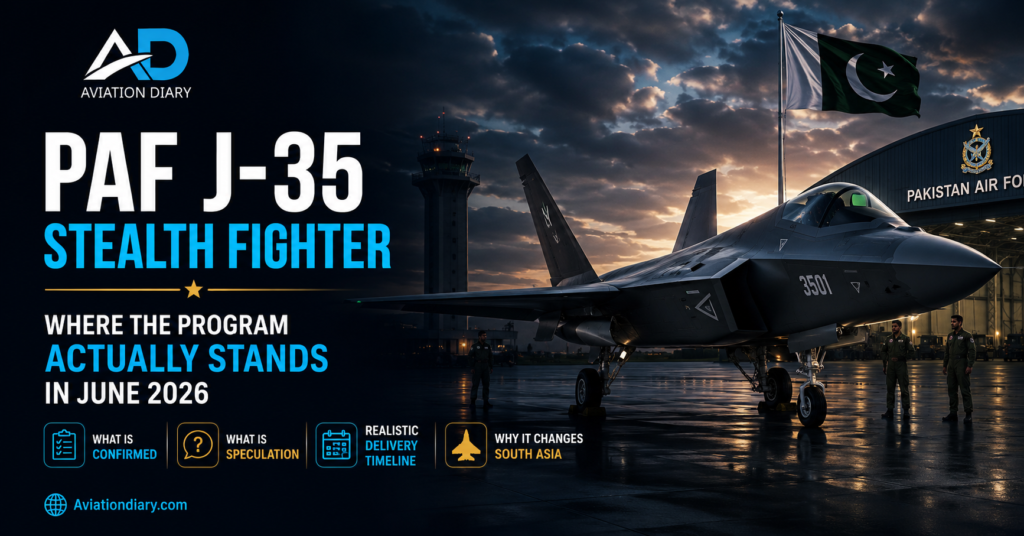

The PAF J-35 stealth fighter story has been running for nearly two years—and most of what circulates online is either premature celebration or deliberate noise. At AviationDiary.com, we cut through both. This is a factual breakdown of where the program actually stands in June 2026: what Pakistani officials have confirmed on record, what remains unverified speculation, and what a realistic delivery timeline looks like based on available evidence.
What Is the PAF J-35 Stealth Fighter?
The J-35 is a twin-engine, fifth-generation stealth fighter developed by China’s Shenyang Aircraft Corporation. It was designed as a lighter, export-oriented counterpart to the heavier J-20 and evolved from the earlier FC-31/J-31 prototype program. The export variant relevant to Pakistan is designated the J-35AE.
The J-35 is a medium-weight stealth fighter with a twin-engine layout, a single-seat cockpit, and internal weapons carriage designed to reduce radar cross-section. The airframe incorporates diverterless supersonic inlets. For the PAF, the PAF J-35 stealth fighter would represent a generational leap — introducing low-observable technology and sensor fusion that neither the JF-17 Thunder nor the J-10CE currently provides.
What Is Actually Confirmed
This is the only section that matters for credibility. Here is what Pakistani officials have said on record.
January 2024 — Air Chief lays the groundwork. PAF Chief of Air Staff Air Chief Marshal Zaheer Ahmed Baber Sidhu announced that the Defence Ministry was preparing to place an order for Chinese fifth-generation fighters, stating: “The foundation for acquiring the J-31 stealth fighter aircraft has already been laid, which is all set to become part of the fleet in the near future.” The J-31 designation was in use at the time; it has since been updated to J-35.
June 2025 — Framework agreement signed. Pakistan signed a framework agreement in principle for up to 40 J-35 export variants following high-level talks in Beijing in June 2025, potentially making Islamabad the first export customer of the twin-engine fifth-generation platform.
May 7, 2026 — Official confirmation at ISPR press briefing. This is the most significant development to date. At a press conference in Islamabad, PAF Deputy Chief of Air Staff Air Vice-Marshal Tariq Ghazi confirmed that the PAF has signed an “initial collaborative agreement” for the acquisition of the fifth-generation Shenyang J-35 stealth fighter, without disclosing details about the scope of the deal. Ghazi confirmed the deal but did not disclose the number of aircraft or financial terms. He told reporters that “foundations have been laid” for acquiring long-range precision weapons, next-generation platforms, additional J-10C aircraft, and significantly upgraded JF-17 fighters.
When asked about the induction of the PAF J-35 stealth fighter, Ghazi said the Pakistan Air Force had established an “initial collaborative mechanism” on the aircraft and that the option would be available before the requirement emerged.
That last phrase — before the requirement emerged — is deliberate signaling. It means the PAF is positioning itself to receive the jet when needed, not that delivery is imminent.
Pilot training has begun — on the ground. Pilot conversion training for selected PAF officers is understood to have begun in China but remain at the simulator and ground school stage.
What Is the PAF J-35 Stealth Fighter Deal Package?
The acquisition is not just about the aircraft. The Shehbaz Sharif administration publicly acknowledged that Pakistan had been offered 40 fifth-generation Shenyang J-35 stealth aircraft, Shaanxi KJ-500 airborne early warning and control aircraft, and HQ-19 air defense systems from China—signaling a coherent, layered airpower concept rather than a standalone fighter acquisition.
A Pakistani analyst described the Chinese package as “an ecosystem rather than merely an aircraft purchase” because the J-35, KJ-500, and HQ-19 combination multiplies Pakistan’s lethality, survivability, and operational reach simultaneously.
The PAF J-35 stealth fighter, in other words, is the centerpiece of a broader network-centric warfare upgrade — not a single platform purchase. That distinction matters because it also means the financial and infrastructure requirements are substantially larger than just buying jets.
What Is Pure Speculation
Social media has been running ahead of reality on the PAF J-35 stealth fighter story for over a year. Here is what does not hold up to scrutiny.
Viral March 2026 delivery claims are false. Viral claims sweeping social media platforms alleged that the Pakistan Air Force had taken delivery of its first batch of six J-35 stealth fighters from China. Defense sources categorically rejected the reports, stating no official announcement, aircraft photographs, or supporting airfield activity existed.
No aircraft have arrived. No aircraft have been ferried or accepted into Pakistani service according to aviation tracking data and satellite imagery of relevant airbases. The PAF J-35 stealth fighter is a program in preparation — not in possession.
Discounted pricing claims — unverified. Reports alleging China may subsidize up to 50 percent of the cost as part of a strategic partnership arrangement have not been officially detailed by either government.
The “initial collaborative agreement” is not a full contract. The May 2026 announcement used carefully qualified language. An initial collaborative mechanism is not a signed procurement contract with delivery schedules, payment terms, or accepted airframes.
When Could Pakistan Actually Get the PAF J-35 Stealth Fighter?
This is the question most outlets get wrong—either by being too optimistic to generate clicks or by dismissing the program entirely.
The honest answer: late 2026 at the earliest or 2027 as the more realistic window.
Reports from mid-2025 indicated an initial batch of four to twelve J-35 fighters arriving as early as 2026, with the remainder of a 40-unit tranche following by 2027. The J-35A is still in pre-series production for China’s own air force, and the absence of an official contract announcement introduces additional uncertainty.
Senior officials familiar with the program told local defense correspondents that the earliest possible delivery window remains 2027 at best. The J-35 program itself only entered limited series production for the Chinese People’s Liberation Army Air Force and Navy in late 2025.
That production sequencing is the key constraint. Procurement timelines remain governed by production capacity at Shenyang facilities currently prioritizing domestic PLA requirements. Pakistan gets what China can spare after its own air force and navy are supplied.
Speculation is rife that Pakistan could take delivery of an initial batch of J-35s by the end of 2026, following the airing of a video by CCTV showing the first fully operational export version of the warframe. That CCTV broadcast — showing a J-35AE variant without PLA markings — was widely read as a deliberate signal that China is ready to export. If Beijing accelerates PAF delivery to demonstrate export capability, end-2026 becomes plausible. If Shenyang’s domestic queue takes priority, 2027 is the floor.
Why the PAF J-35 Stealth Fighter Changes Everything in South Asia
India currently operates no fifth-generation fighter in squadron service. India’s Rafale fleet numbers around 36 aircraft with more on order, relying on fourth-generation-plus capabilities alongside Su-30MKI numbers exceeding 260 units. India’s Advanced Medium Combat Aircraft program targets prototype rollout in 2026–27, first flight around 2028–29, and induction no earlier than 2034–35.
If the PAF J-35 stealth fighter enters service before 2030, Pakistan will hold a stealth advantage over India for at least a decade — the first time in the history of South Asian airpower that Islamabad has held a qualitative edge in fighter technology over New Delhi.
Defense analysts say the induction of J-35 stealth jets would alter the air power balance between Pakistan and India. A professor of international politics at Lancaster University said the technology transfer would “massively strengthen” the China-Pakistan all-weather strategic partnership significantly.
That strategic dimension is precisely why both Islamabad and Beijing are managing the public narrative carefully—confirming enough to signal capability while withholding enough to preserve operational surprise.
Bottom Line
The PAF J-35 stealth fighter program is real, confirmed at the official level, and advancing. An initial collaborative agreement exists. Pilot training in China has begun. Infrastructure upgrades at PAF bases are reportedly underway. The full procurement package—jets, KJ-500 airborne early warning aircraft, and HQ-19 missile defense—has been officially acknowledged by the Pakistani government.
What does not exist yet: a signed full contract with disclosed terms, delivered airframes, or an official induction date. Anyone telling you the PAF already has J-35s is wrong. Anyone telling you it will never happen is equally wrong.
The realistic window is late 2026 to 2027 for an initial batch of 4 to 12 aircraft. Full squadron strength of 40 jets follows by 2028 if production and financing stay on track.
Aviation Diary will report the moment those jets land on Pakistani soil. Until then, this is where the program actually stands.
Aviation Diary Editorial editor@aviationdiary.com AviationDiary.com

Your Window to the World Above!