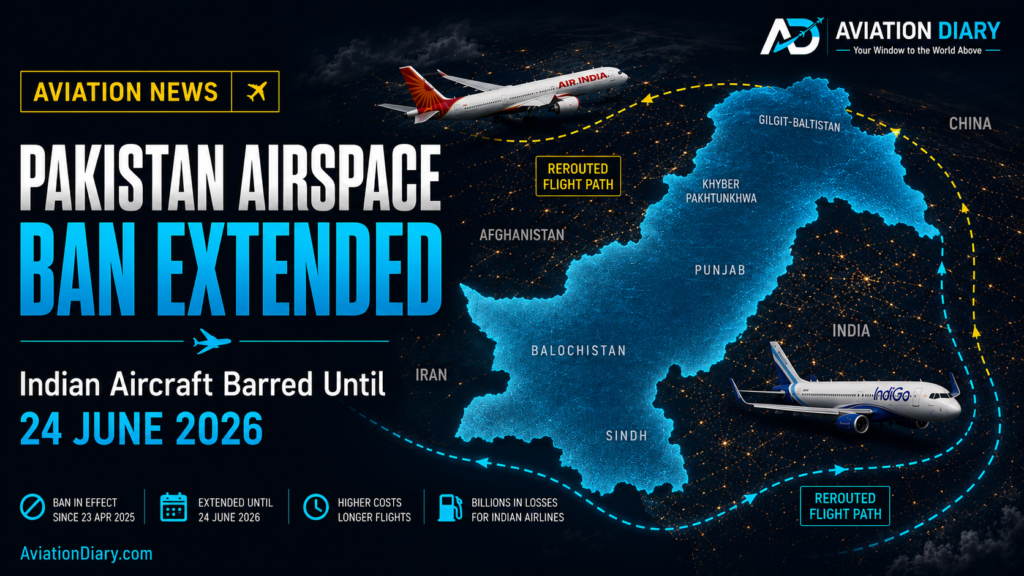

The Pakistan Airports Authority (PAA) has extended its airspace closure for Indian aircraft until 4:59 AM PKT on June 24, 2026. Formalized through a fresh Notice to Airmen (NOTAM), the Pakistan airspace ban 2026 continues a restriction that has been in place since April 2025—making it one of the longest sustained airspace closures between two neighboring countries in recent aviation history.
With the June 24 deadline now days away, the aviation industry is asking one question: Will Pakistan lift the ban or extend it again?
What the Pakistan Airspace Ban 2026 Covers
The latest NOTAM issued by the PAA is comprehensive. It bars all aircraft registered in India from transiting Pakistani airspace, covering both of Pakistan’s flight information regions—Karachi FIR and Lahore FIR. The Pakistan airspace ban 2026 applies to Indian commercial airlines, military aircraft, privately owned planes belonging to Indian citizens, and any aircraft leased, operated, or managed by Indian entities.
This restriction is not limited to flag carriers. Every Indian airline — Air India, IndiGo, SpiceJet, and others — operating westbound international routes is directly affected. The ban removes Pakistan’s airspace as a transit corridor for flights heading toward Europe, the Middle East, and Central Asia.
How the Pakistan Airspace Ban 2026 Started
The Pakistan airspace ban 2026 was first imposed on April 23, 2025, following a sharp escalation in India-Pakistan tensions after an attack in Pahalgam, Indian-occupied Kashmir. India blamed Pakistan for the attack without presenting evidence. Pakistan rejected the accusation and called for a neutral international investigation.
India responded by closing its own airspace to Pakistani airlines on April 30, 2025. The two countries then fought a brief but intense military conflict lasting approximately 87 hours before a US-brokered ceasefire took effect on May 10, 2025. Despite the ceasefire, neither country restored airspace access to the other.
The Pakistan airspace ban 2026 has been renewed every month since June 2025, July 2025, and continuing through multiple extensions into 2026. Each renewal follows ICAO guidelines, which require airspace restrictions to be reissued in maximum one-month increments.
“Pakistan’s air traffic control network, managed by the PCAA, continued operating normally throughout the conflict period—a subject we covered in detail in our guide to becoming an Air Traffic Controller in Pakistan.”
Financial Impact of the Pakistan Airspace Ban 2026 on Indian Airlines
The Pakistan airspace ban 2026 has imposed severe operational costs on Indian carriers. With Pakistani skies off-limits, airlines are forced onto significantly longer alternative routing — typically south over the Arabian Sea or north through Central Asian corridors — to reach Europe and the Middle East.
Air India estimated it faced roughly $600 million in additional costs if the ban lasted a full year. That figure has now been exceeded in duration. IndiGo, India’s largest carrier by market share, and other private airlines have absorbed billions of rupees in additional fuel expenditure and increased crew costs due to longer flight times.
Passenger-facing consequences include higher airfares on India-Europe routes, longer flight durations, and reduced schedule frequency on some services. The Pakistan airspace ban 2026 effectively adds 1.5 to 3 hours to certain westbound routes from Indian airports.
Why Pakistan’s Aviation Sector Remains Largely Unaffected
Unlike Indian carriers, Pakistani airlines do not rely on Indian airspace for their international operations. Pakistan’s major routes—to the Gulf, UK, Europe, and Southeast Asia — do not require overflight of Indian territory. As a result, the reciprocal ban India imposed on Pakistani airlines has had minimal operational impact on carriers like PIA, Airblue, and Fly Jinnah.
This asymmetry is significant. The Pakistan airspace ban 2026 costs India billions while costing Pakistan relatively little, giving Islamabad limited aviation-sector incentive to lift the restriction ahead of broader diplomatic progress.
For readers interested in how Pakistani carriers are navigating the current environment, see our coverage of Airblue’s captain recruitment drive.
What Happens After June 24?
As of publication, no announcement has been made regarding lifting the Pakistan airspace ban 2026 after the June 24 deadline. Based on the pattern established over the past 14 months, another monthly extension is the most likely outcome unless a significant diplomatic breakthrough occurs between the two governments.
Back-channel diplomatic contacts between India and Pakistan have been reported intermittently, but no formal talks on normalizing bilateral relations — including airspace — have been confirmed. Until the underlying political dispute is resolved, the Pakistan airspace ban 2026 is expected to remain in place indefinitely.
For global passengers and airlines planning routes through South Asia, this means continued rerouting, higher costs, and longer journey times for the foreseeable future.
Pakistan Airspace Ban 2026 — A Broader Signal for Global Aviation
The Pakistan airspace ban 2026 is a textbook example of how geopolitical conflict directly disrupts commercial aviation. It echoes the closure of Russian airspace to European carriers following the Ukraine conflict—a restriction that fundamentally reshaped routing economics across an entire hemisphere.
For aviation professionals and analysts, the Pakistan-India airspace standoff demonstrates that bilateral tensions between two neighboring countries can produce wide-ranging disruptions affecting passengers, airlines, and air traffic management systems across an entire region.
Pakistan’s PAA has confirmed the current restriction through June 24. Whether that date marks another extension or the beginning of normalization depends entirely on events far beyond the runway.
Stay updated with AviationDiary for the latest on Pakistan airspace news, South Asia aviation developments, and global aviation coverage.

Your Window to the World Above!