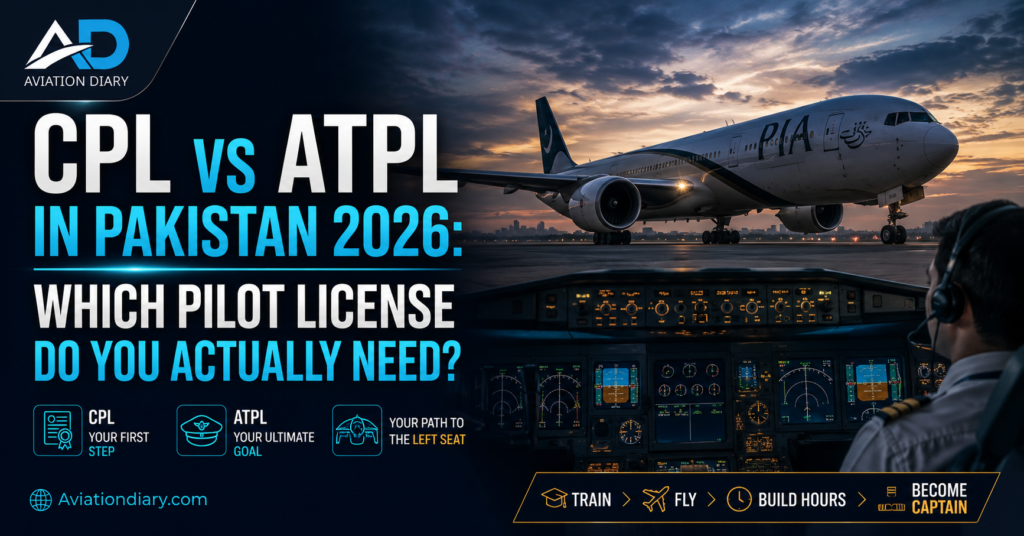

Every week at AviationDiary, aspiring pilots ask us the same question — “Do I need a CPL or an ATPL to fly for a Pakistani airline?” It’s one of the most misunderstood topics in Pakistan’s aviation training space, and the confusion costs students real time and real money.
This guide answers the CPL vs ATPL in Pakistan question completely — what each license is, what it allows you to do, how you get it, and exactly how the two fit together on the path to an airline cockpit. If you haven’t read our foundational guide on how to become a pilot in Pakistan yet, start there—this article picks up where that one leaves off.
CPL vs ATPL in Pakistan: Understanding the Full Picture First
Before breaking down the differences, you need to understand one thing clearly: CPL and ATPL are not alternatives. They are sequential. You don’t choose one over the other—you earn the CPL first, and the ATPL comes years later once you’ve logged the required hours on airline aircraft.
Here’s the journey at a glance:
- Stage 1: Complete CPL training at a PCAA-approved flying school
- Stage 2: Pass ATPL theoretical knowledge exams during or after CPL training (Frozen ATPL)
- Stage 3: Get hired as a First Officer at a Pakistani airline — PIA, Airblue, AirSial, Serene Air, or Fly Jinnah
- Stage 4: Accumulate the required flight hours as First Officer
- Stage 5: Apply for your full ATPL through PCAA — Captain upgrade eligible
Understanding this sequence is the foundation of the entire CPL vs ATPL in Pakistan discussion. Everything else flows from it.
What Is a CPL and What Does It Authorize You to Do?
A Commercial Pilot License (CPL) is the minimum certification that allows you to be paid to fly an aircraft. Under PCAA regulations, a CPL holder can:
- Act as Pilot-in-Command (PIC) on single-pilot commercial operations
- Serve as First Officer (co-pilot) on multi-crew commercial aircraft—which covers every scheduled airline in Pakistan
In practical terms, a CPL gets you in the right seat of an Airbus A320 or ATR 72 and earns you a First Officer salary. That is the direct entry point into a commercial airline career in Pakistan.
PCAA CPL Minimum Requirements
- Minimum age: 18 years
- Total flight hours: 200 hours (including cross-country, instrument, and nighttime)
- Medical: PCAA Class 1 Medical Certificate
- Theory exams: Air Law, Meteorology, Navigation, Aircraft General Knowledge, Flight Performance & Planning, Human Performance
- Skill test: Conducted with a PCAA-authorized examiner
The CPL is what you spend money on and train for. When people discuss the cost of becoming a pilot in Pakistan—PKR 35 to 55 lakh at a local ATO—they’re talking about CPL training. The CPL vs ATPL cost picture in Pakistan is heavily weighted toward the CPL phase, because the ATPL is primarily earned through years of airline flying, not a separate expensive course.
What Is an ATPL and Why Does It Matter for Your Airline Career?
The Airline Transport Pilot License (ATPL) is the highest pilot certification issued by PCAA. It is the only license that qualifies you to act as Pilot-in-Command (Captain) on a multi-crew commercial aircraft. Without a full ATPL, you will never sit in the left seat as Captain on a PIA Boeing 777, an Airblue A320, or any other scheduled airline aircraft in Pakistan.
This is why the CPL vs ATPL in Pakistan distinction matters most: the CPL makes you a First Officer, the ATPL makes you a Captain.
Two Versions of the ATPL You Need to Know
Frozen ATPL
This is the status you hold when you have passed all ATPL theoretical knowledge exams but have not yet accumulated the required 1,500 flight hours. Most Pakistani cadets who complete an integrated CPL course graduate with a CPL and a Frozen ATPL simultaneously—the theory is done; the license “unfreezes” once the hours are logged on the job.
Full ATPL
The full, active license — issued by PCAA once you meet all hour thresholds and pass the ATPL skill test. This is what triggers your eligibility for a Captain upgrade at any Pakistani airline.
PCAA ATPL Minimum Requirements
- Total flight hours: 1,500 hours
- Pilot-in-Command hours: 500 hours
- Multi-engine instrument time: 100 hours
- Night flying: 100 hours
- Cross-country as PIC: 200 hours
- Medical: PCAA Class 1 Medical Certificate (maintained continuously)
CPL vs ATPL in Pakistan: Side-by-Side Comparison
| CPL | Full ATPL | |
|---|---|---|
| Minimum flight hours | 200 hours | 1,500 hours |
| Role on airline | First Officer only | Captain eligible |
| Left seat command | Not permitted on multi-crew | Permitted |
| Theory exams | CPL subjects (6 papers) | ATPL subjects (advanced, more papers) |
| Typical timeline | 18–24 months from zero | 8–12 years from zero |
| Who pays for it | You (PKR 35–55 lakh) | Hours built on airline payroll |
| Issued by | PCAA | PCAA |
The most important row in that table: the ATPL is primarily time, not money. After your CPL, the path to a full ATPL runs through years of airline flying — not a new course you enroll in.
How CPL vs ATPL in Pakistan Works in Real Career Sequence
Here’s the realistic, step-by-step path a Pakistani aviation student follows:
Step 1 — Student Pilot License (SPL) and PPL
You begin with your SPL, then build hours toward your Private Pilot License (PPL)—roughly 45 to 55 hours of flight time. At most PCAA-approved ATOs in Pakistan, PPL training is bundled into the integrated CPL course rather than sold separately.
Step 2 — CPL + Instrument Rating + Frozen ATPL Theory
This is the core of your training investment. You complete your 200 flight hours, pass your CPL skills test with a PCAA examiner, earn your Instrument Rating (IR), and simultaneously sit the ATPL theoretical knowledge exams. When you graduate, you hold a CPL/IR and a Frozen ATPL.
For a complete breakdown of this stage — costs, school selection, and what to expect — read our guide on how to become a pilot in Pakistan.
Step 3 — Type Rating
No Pakistani airline will hire you without a Type Rating on the specific aircraft you’ll fly. An A320 type rating typically costs USD 15,000 to 25,000. Some airlines sponsor this cost for cadets; others expect you to self-fund. Confirm this directly with any airline you’re applying to.
Step 4 — First Officer at a Pakistani Airline
With your CPL/IR, Frozen ATPL, and Type Rating, you’re eligible to apply as a First Officer at PIA, Airblue, Fly Jinnah, AirSial, or Serene Air. This is where the hour-building begins in earnest. You’re earning a salary and accumulating the 1,500 hours you need to unfreeze your ATPL.
Step 5 — Full ATPL and Captain Upgrade
Once you’ve met all PCAA hour requirements, you apply for your full ATPL. With it, you become eligible for a Captain upgrade—typically 8 to 12 years after your initial CPL, depending on airline seniority lists and fleet expansion.
This is the full arc of the CPL vs ATPL in Pakistan journey. It’s long. Knowing the timeline upfront is what separates pilots who plan well from those who burn out mid-career without a clear destination.
Which PCAA-Approved Schools Offer ATPL Theory Training in Pakistan?
Not every flying school in Pakistan is approved by PCAA for ATPL ground school. If you want to graduate with a Frozen ATPL alongside your CPL — and you should — verify that your school offers an integrated CPL/ATPL theory program before enrolling.
The major PCAA-approved ATOs currently operating include:
Karachi Aero Club — The subcontinent’s oldest flying institution, operating from Jinnah International Airport. Offers an established integrated CPL/IR program. One of the most recognized names when Pakistani airlines review applications.
Rawalpindi Flying Club — Based in Islamabad, long track record of producing First Officers hired by domestic carriers.
PAC Flying Training Institute, Risalpur — Connected to Pakistan Air Force infrastructure, highly respected program.
Pegasus Aviation Academy — Lahore-based, relatively newer but PCAA-approved and growing in reputation.
Always verify current ATO approval status directly with PCAA before committing. Approvals are subject to review and can change.
CPL vs ATPL in Pakistan: What It Actually Costs
CPL Training (Pakistan-Based ATO)
- Integrated PPL to CPL/IR course: PKR 35–55 lakh
- PCAA theory exam fees: PKR 50,000–80,000
- PCAA Class 1 Medical: PKR 15,000–25,000
CPL Training Abroad (UK, USA, South Africa)
- Total cost: USD 60,000–120,000
- Higher cost, internationally recognized license, often preferred by foreign carriers
- PCAA license conversion required to fly domestically
Type Rating (Post-CPL, Pre-Airline)
- A320 or B737 Type Rating: USD 15,000–25,000
- Some airlines co-fund or fully sponsor—confirm with each carrier
ATPL Unfreezing
No separate course cost. The full ATPL is issued by PCAA once hour requirements are met. The investment here is time on the job, not tuition fees.
The honest CPL vs ATPL cost picture in Pakistan: you spend money on the CPL, and you spend years on the ATPL.
The Four Mistakes Pakistani Pilot Students Make on This Topic
Mistake 1: Thinking CPL and ATPL Are Alternatives
They are not. CPL is stage one. ATPL is the destination. You pursue both on the same career path, not as separate options.
Mistake 2: Skipping ATPL Theory During CPL Training
Some students take a standalone CPL without sitting the ATPL theory papers. This is a false economy. Those exams have a validity window—if you don’t complete your hours before they expire, you’ll resit them out of sequence, which is harder and more disruptive.
Mistake 3: Choosing a Flying School on Price Alone
A cheaper school that doesn’t hold PCAA ATO approval leaves you with unrecognized flight hours. No Pakistani airline will count them. Verify PCAA status first — always.
Mistake 4: Ignoring the Medical Until After Enrolling
A PCAA Class 1 Medical disqualification ends a pilot career before it starts. Get your medical assessment done before you spend a rupee on training. This is the single most important logistical step in the entire journey, as we covered in detail in our guide on how to become a pilot in Pakistan.
Frequently Asked Questions — CPL vs ATPL in Pakistan
Can I fly for a Pakistani airline with just a CPL?
Yes—as a First Officer. A CPL qualifies you for co-pilot roles on all commercial multi-crew aircraft. You cannot act as Captain without a full ATPL.
How long does it take to get a full ATPL in Pakistan?
Realistically, 8 to 12 years from starting your PPL—accounting for 18 to 24 months of initial training, plus the years of airline flying needed to reach 1,500 hours.
What is a Frozen ATPL and do I need one?
A Frozen ATPL means you’ve passed all ATPL theory exams but haven’t yet reached the 1,500-hour threshold. Most integrated CPL courses in Pakistan include ATPL theory, so you graduate with a Frozen ATPL automatically. You want this — it means your full ATPL activates the moment you hit your hours, with no additional theory exams required.
Does PCAA accept a CPL earned abroad?
PCAA has a license conversion process for ICAO-compliant licenses from recognized states. It requires written exams and a skill test. Confirm current requirements directly with PCAA, as these are updated periodically.
What happens if my ATPL theory credits expire?
ATPL theory exam credits have a validity period. If you don’t accumulate the required hours within that window, you may need to resit some or all papers. Confirm current PCAA validity rules before you begin your training to plan accordingly.
Conclusion
The CPL vs ATPL in Pakistan question has a straightforward answer once you understand the structure: the CPL gets you hired as a First Officer, and the ATPL makes you a Captain. You’re not choosing between them—you’re working toward both, in sequence, across an 8 to 12-year career arc.
The students who navigate this path successfully are the ones who understand the full timeline from day one, choose a PCAA-approved ATO that covers ATPL theory, clear their medical before spending any money, and treat the First Officer years as the investment they are—not just a job, but the hours that unlock the Captain’s seat.
If you’re still at the starting line, our complete guide on how to become a pilot in Pakistan covers everything from PCAA eligibility requirements to flying school selection to your first airline interview. That’s where the journey begins.
editor@aviationdiary.com
AviationDiary.com — Pakistan’s aviation media platform

Your Window to the World Above!