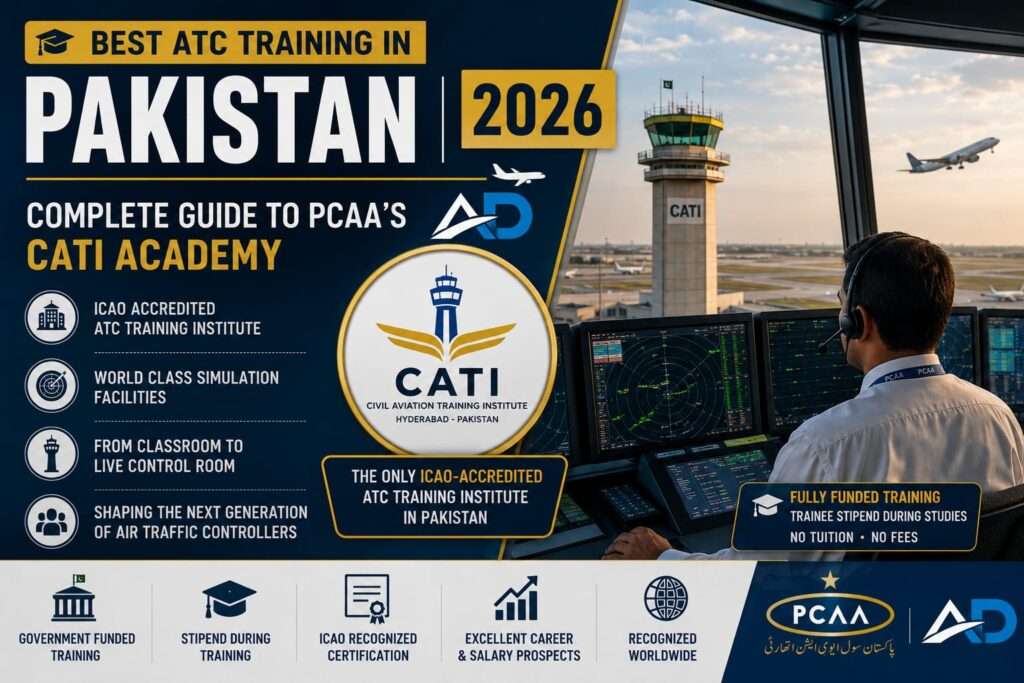

If you’ve decided that air traffic control is your career path, your next question is straightforward: where do you get the best ATC training in Pakistan? Unlike pilot training, where you can choose between Karachi Aero Club, PIA Flying Academy, and Airborne Aviation, ATC training in Pakistan flows through one institution—the Civil Aviation Training Institute, universally known as CATI. It is the only ICAO-accredited ATC training facility in the country, and it is where every Pakistani air traffic controller gets their foundational qualification. This guide covers everything you need to know about CATI, what the best ATC training in Pakistan actually involves, and how to position yourself for selection.
Aviation Diary has covered the broader ATC career landscape in detail — if you are still deciding whether to pursue this path, start with our complete guide on air traffic control in Pakistan before reading on. For those already committed, this guide takes you directly into the training institution itself.
Best ATC Training in Pakistan: Why CATI Is the Only Answer
The Civil Aviation Training Institute is located in Hyderabad, Sindh, and operates under the Pakistan Airports Authority. CATI was established in 1982 to meet the training requirements of the PCAA and aviation authorities of the wider region. Since then it has grown into one of the most respected aviation training institutions in South Asia.
CATI is accredited by the International Civil Aviation Organization and is a member of the ICAO TRAINAIR PLUS Program—the global network of aviation training excellence. That ICAO accreditation is what makes CATI the only valid source of best ATC training in Pakistan for anyone pursuing a licensed career in Pakistani airspace. Training credentials from non-ICAO-accredited institutions are not recognized by PCAA for licensing purposes.
CATI’s reach extends well beyond Pakistan’s borders. The institution has trained aviation professionals from over 50 countries across Asia, Africa, and the Middle East—making it a regional hub for the best ATC training in Pakistan and beyond.
What CATI Teaches: The Four Schools
CATI is structured around four specialized schools, each targeting a distinct area of aviation operations. These are the School of Aviation Management, the School of Regulatory Services and Functions, the School of Air Navigation Services, and the School of Airport Services.
For candidates pursuing the best ATC training in Pakistan, the relevant school is the School of Air Navigation Services.
School of Air Navigation Services — The ATC Training Core
The objective of the School of Air Navigation Services is to impart comprehensive and high-quality training through classroom lectures, simulation exercises, and performance evaluations to individuals in Air Traffic Control, Communication Operations, and CNS — Communication, Navigation and Surveillance — Engineering. The school aims to produce skilled, competent, and responsible aviation professionals who will play a vital role in ensuring the safety, order, and efficiency of the aviation system.
This school is divided into two departments. The first is Air Traffic Services and Communication Operations, which covers live ATC training, including aerodrome control, approach control, and area control—the three core disciplines every licensed controller must master. The second is Communication, Navigation and Surveillance Engineering, which trains the technical specialists who maintain the radar, radio, and navigation infrastructure that ATC operations depend on.
For most candidates seeking the best ATC training in Pakistan through the operational controller route, the ATS and Communication Operations department is where your training takes place.
What Best ATC Training in Pakistan Actually Covers
The best ATC training in Pakistan at CATI follows ICAO-standardized curriculum. Here is what the core training program covers:
Phase 1 — Ab Initio Ground School
This is the foundational classroom phase. Subjects covered include air law and ICAO regulations, meteorology and weather interpretation, navigation principles, air traffic services procedures, aviation English and ICAO phraseology, human performance and limitations, and aerodrome and airspace structure. Every subject is examined. Candidates who do not meet the required pass mark in any subject are required to repeat it before progressing.
Phase 2 — Simulation Training
CATI’s best ATC training in Pakistan uses simulation exercises as a core training methodology. Trainees work on ATC simulators that replicate live radar screens, radio communication environments, and real Pakistani airspace scenarios. Simulation training is where theoretical knowledge gets tested against time pressure, simultaneous traffic, and decision-making stress—the conditions that define real ATC work.
CATI operates dedicated simulation labs for both aerodrome and radar control training. This infrastructure is what separates the best ATC training in Pakistan at CATI from any alternative — there is no comparable simulation facility at any other institution in the country.
Phase 3 — On-the-Job Training
After clearing ground school and simulation, trainees are posted to an operational ATC unit—Karachi, Lahore, Islamabad, or another PCAA facility—for supervised live traffic handling. An experienced, licensed controller supervises every trainee action until the trainee demonstrates consistent competency across all required skill areas. OJT duration varies by individual progress and facility traffic complexity.
Successful OJT completion leads to the Student Air Traffic Controller License issued by PCAA, which is upgraded to a full Air Traffic Control License upon validation of all competency standards.
CATI’s International Standing — Why It Matters for Your Career
The best ATC training in Pakistan at CATI carries weight beyond Pakistan’s borders. CATI delivers ICAO-aligned training and capacity building for aviation professionals, with a focus on enhancing safety, security, and operational efficiency through modern facilities, experienced instructors, and ICAO-recognized course standards.
That ICAO recognition matters enormously if your career ambitions extend beyond Pakistan. Gulf-based ANSPs — particularly in the UAE, Qatar, Saudi Arabia, and Bahrain — actively recruit Pakistani ATC officers. Controllers trained at an ICAO TRAINAIR PLUS member institution like CATI carry credentials that those employers recognize and respect. The best ATC training in Pakistan at CATI is not just a domestic qualification—it is a regionally portable one.
Eligibility: Who Can Apply for the Best ATC Training in Pakistan
Access to the best ATC training in Pakistan through CATI is not open enrollment. Candidates are selected by PCAA through a competitive recruitment process, and only selected candidates are sponsored into CATI’s ATC training program. There is no direct civilian application to CATI for ATC training independent of PCAA selection.
The eligibility requirements for PCAA ATC recruitment — which is the gateway to CATI — are as follows:
Academic qualification: Minimum FSc (Pre-Engineering or Pre-Medical) with Physics and Mathematics, or equivalent A-Levels. A Bachelor’s degree strengthens your application but is not mandatory at the entry level.
Age limit: Between 18 and 28 years at the time of application. Government-notified relaxations may apply in specific categories.
Medical fitness: Class 3 Medical Certificate standard as defined by ICAO. Vision, hearing, cardiovascular, and neurological standards all apply. Get your medical assessment done before investing time in preparation — it is a non-negotiable gate.
English proficiency: Genuinely strong spoken and written English. ATC communication with pilots is conducted entirely in English using ICAO phraseology. Functional English is not sufficient — you need confident, clear, real-time spoken fluency.
Nationality: Pakistani national with a valid CNIC.
PCAA recruitment announcements are published on the official PCAA website and in national newspapers. Aviation Diary tracks government aviation vacancies — check our PAA Jobs 2026 page for the latest openings across Pakistan’s aviation sector.
ATC Training Cost in Pakistan: The Best News You’ll Read Today
The most common route into ATC is through sponsorship by a national Air Navigation Service Provider. In this model, the organization covers the entire cost of training. Furthermore, trainees often receive a salary or a bursary during their studies, effectively being paid to learn.
Pakistan follows this model. When PCAA selects you for ATC training, CATI training is fully funded by the authority. You do not pay tuition. You do not pay simulation lab fees. You receive a trainee stipend while you study. This is one of the most significant advantages the best ATC training in Pakistan has over the CPL pilot route, where candidates must self-fund PKR 3.5 million or more in training costs.
The financial barrier to entry for ATC in Pakistan is your ability to pass the selection process — not your ability to pay.
ATC Salary in Pakistan After CATI Training
The salary outcome of completing the best ATC training in Pakistan is one of the strongest in the country’s aviation sector.
The average salary for an air traffic controller in Pakistan is PKR 172,490 per month, which is 78% higher than the national average. Top earners have reported making up to PKR 405,152 per month at the 90th percentile.
For senior and federal-level controllers, the figures are significantly higher. The average pay for a federal air traffic controller in Pakistan is PKR 4,218,035 per year, with the salary range spanning from PKR 2,880,918 to PKR 5,158,657 annually.
That salary package, combined with government job security, medical coverage, pension entitlement, and operational allowances, makes a career built on the best ATC training in Pakistan one of the most financially compelling options in Pakistani aviation — without the multi-million rupee upfront training investment that the pilot route requires.
CATI vs Self-Study ATC Courses: What You Need to Know
A number of private institutions and online platforms market ATC preparation courses in Pakistan. To be clear: no private institution in Pakistan provides the best ATC training in Pakistan for licensing purposes. PCAA only recognizes ATC training conducted at CATI for the issuance of Pakistani ATC licenses. Private courses can help you prepare for the PCAA written selection test and aptitude assessment, but they are not a substitute for CATI’s licensed training program.
If you are using private courses or self-study resources to prepare for the PCAA selection test, that is legitimate and useful. If anyone tells you that a private institute certificate qualifies you to work as a licensed air traffic controller in Pakistan without PCAA-sponsored CATI training, that is factually incorrect.
How to Maximize Your Chances of Selection for the Best ATC Training in Pakistan
Stay current on PCAA recruitment cycles. There is no fixed annual recruitment window. Check the PCAA website, national newspapers, and Aviation Diary’s jobs coverage regularly. Missing an application deadline means waiting for the next cycle, which can be 18 to 36 months away.
Strengthen your English before applying. The PCAA selection interview tests spoken English under mild pressure. Practice articulating technical concepts clearly and confidently. IELTS preparation, even without taking the exam, is a practical way to build the English standard PCAA expects.
Get your Class 3 medical done early. Do not prepare for six months and then discover at the medical gate that a correctable condition disqualifies you temporarily. Get the medical assessment done first so you know exactly where you stand before investing preparation time.
Build your aviation knowledge base. PCAA’s written test includes aviation general knowledge. Aviation Diary’s published guides on Pakistan’s aviation sector, ATC careers, and military aerospace give you a strong foundation. Our complete guide on air traffic control in Pakistan is an essential starting point for understanding the industry context before sitting the selection test.
Aviation Diary’s Final Word
The best ATC training in Pakistan lives at one address: CATI, Hyderabad. It is ICAO-accredited, government-funded, and the only institution whose training PCAA recognizes for ATC licensing. The path to get there runs through PCAA’s competitive selection process—and for candidates who clear that process, the training is fully funded, and the career that follows is one of the strongest in Pakistani aviation.
If you are serious about the best ATC training in Pakistan, the preparation starts now. Build your English, maintain your academic record, monitor PCAA recruitment announcements, get your medical assessment done, and stay consistent. CATI will do the rest.
Aviation Diary will continue tracking PCAA recruitment announcements and ATC career developments in Pakistan. Keep an eye on our PAA Jobs 2026 page and our full air traffic control in Pakistan guide for updates.

Your Window to the World Above!