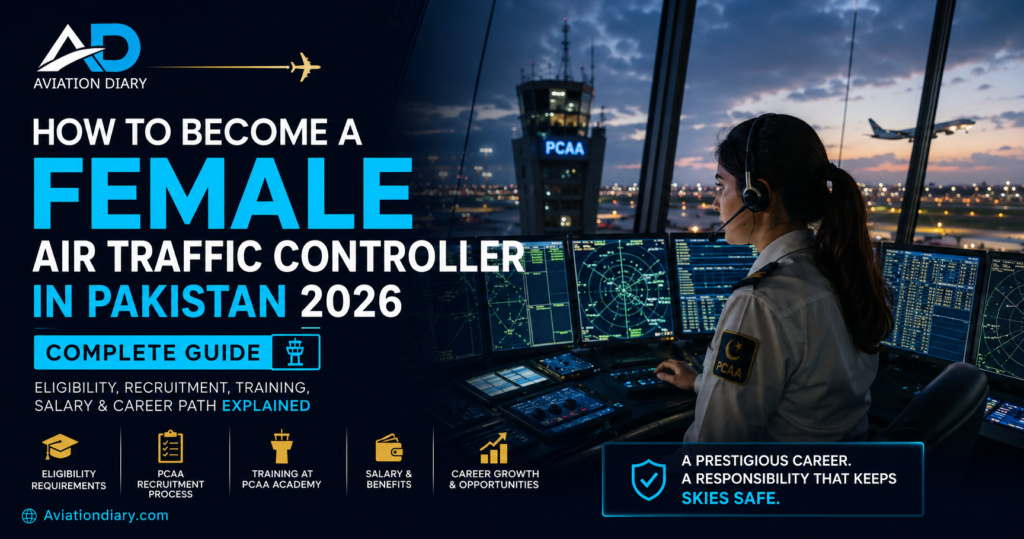

Pakistan’s aviation sector is opening more doors for women than ever before—and one of the most respected, well-paying, and intellectually demanding roles in that sector is air traffic control. Becoming a female air traffic controller in Pakistan is not only possible, but it is also a structured, merit-based career path with a clear entry requirement, government-backed training, and a salary that outperforms most white-collar professions in the country. This guide covers everything you need to know — eligibility, recruitment, training, salary, and what the career actually looks like on the ground.
If you are mapping out your aviation career options more broadly, Aviation Diary‘s complete guide on air traffic control in Pakistan gives you the full landscape. This article focuses specifically on what a female air traffic controller in Pakistan needs to know in 2026.
What Does a Female Air Traffic Controller in Pakistan Actually Do?
Before the requirements, the role itself deserves clarity. An air traffic controller manages the safe, orderly, and efficient movement of aircraft in Pakistani airspace and on airport surfaces. That means issuing clearances to pilots; sequencing arrivals and departures; managing radar screens; coordinating with adjacent control sectors; and making rapid decisions under pressure—sometimes simultaneously managing multiple aircraft in busy airspace.
The Pakistan Civil Aviation Authority (PCAA) operates the country’s air traffic control network across all major international and domestic airports, including Karachi, Lahore, Islamabad, Peshawar, Quetta, and Sialkot. A female air traffic controller in Pakistan can be posted at any of these facilities depending on vacancy, seniority, and specialization.
This is not a desk job. It is a high-concentration, shift-based operational role that demands precision, composure, and strong English communication skills—the international language of aviation.
Female Air Traffic Controller in Pakistan: No Gender Barrier Exists
This needs to be stated clearly because the misconception persists. There is no restriction on women entering air traffic control in Pakistan. The PCAA recruits on merit. Pakistani women have served as air traffic controllers at major airports, including Karachi and Islamabad, and the numbers have been growing steadily as more female candidates enter the applicant pool.
The role carries the same responsibilities, the same salary structure, and the same career progression for a female air traffic controller in Pakistan as it does for male controllers. What matters to PCAA is your academic record, your medical fitness, your English proficiency, and your performance in the selection process—not your gender.
Eligibility Requirements for a Female Air Traffic Controller in Pakistan
PCAA sets the following minimum eligibility criteria for ATC recruitment. These apply equally to all candidates regardless of gender.
Academic Qualification: A minimum of 50% marks in FSc (Pre-Engineering or Pre-Medical) or equivalent A-Levels with Physics and Mathematics as compulsory subjects. A Bachelor’s degree in a relevant field strengthens your application but is not mandatory at the entry level.
Age Limit: Between 18 and 28 years at the time of application. Age relaxation may apply for candidates from specific categories as per government rules.
Medical Fitness: Candidates must pass a Class 3 Medical Certificate standard, which is the ICAO-defined medical requirement for air traffic controllers. This covers vision, hearing, cardiovascular health, and neurological fitness. Get your medical assessment done early — it is a hard gate that eliminates candidates before any further investment.
English Language Proficiency: Strong spoken and written English is non-negotiable. ATC communication with pilots is conducted entirely in English using ICAO phraseology. PCAA assesses English proficiency as part of the selection process.
Nationality: Pakistani national with a valid CNIC.
How to Apply: The PCAA Recruitment Process for a Female Air Traffic Controller in Pakistan
PCAA does not maintain a rolling open application. Recruitment is announced in cycles—typically published in national newspapers including Dawn and Jang, and on the official PCAA website at pcaa.com.pk. The Pakistan Airports Authority also periodically announces related aviation operations vacancies, which Aviation Diary tracks at our PAA Jobs 2026 page.
The standard selection process for a female air traffic controller in Pakistan follows this sequence:
Step 1— Application Submission: Online or physical application with all academic documents, CNIC, photographs, and domicile certificate submitted within the advertised deadline.
Step 2 — Written Test: A multiple-choice test covering English comprehension, general knowledge, basic physics, and aptitude. This is the first elimination round, and a meaningful percentage of applicants do not pass.
Step 3 — Initial Interview: Shortlisted candidates appear before a PCAA selection panel. Communication skills, confidence, and general aviation awareness are assessed here.
Step 4 — Medical Examination: Selected candidates undergo a comprehensive medical assessment at a PCAA-designated medical facility to confirm Class 3 Medical Certificate fitness.
Step 5 — Final Selection and Training Offer: Candidates who clear all stages are offered a place in the PCAA ATC training program.
Training: What Happens After Selection as a Female Air Traffic Controller in Pakistan
This is where the real work begins. A selected female air traffic controller in Pakistan goes through a structured training program administered by the PCAA Training Academy in Karachi. The training is divided into two phases.
Phase 1 — Ab Initio Training: This is the foundational phase covering aviation theory, ICAO standards and recommended practices, meteorology, navigation, air law, and ATC procedures. It is classroom and simulator based. Trainees receive a stipend during this phase.
Phase 2 — On-the-Job Training (OJT): Trainees are posted to an operational ATC unit and work under the supervision of a certified controller. They handle live traffic under close supervision until they demonstrate the competency required for independent operation. OJT duration varies by facility and individual progress.
Upon successful completion of both phases, the trainee is issued a Student Air Traffic Controller License (SATCL) by PCAA, which progresses to a full Air Traffic Control License (ATCL) once competency standards are validated. A female air traffic controller in Pakistan who holds a valid ATCL is a licensed aviation professional recognized under ICAO standards.
Female Air Traffic Controller in Pakistan: Salary and Benefits
Salary is one of the strongest arguments for this career path. A female air traffic controller in Pakistan working under PCAA’s pay structure earns a competitive government-sector package that includes base pay, allowances, and operational hazard pay tied to active controlling duties.
Entry-level ATC officers at PCAA earn in the range of PKR 80,000 to PKR 120,000 per month at the start of their careers, including allowances. With seniority, specialization in radar control, and progression to supervisory roles, monthly compensation for a senior controller can reach PKR 250,000 to PKR 350,000 or higher. Controllers posted at international airports with higher traffic density typically earn additional operational allowances on top of base salary.
Benefits include job security under government service terms, medical coverage, pension entitlement, and housing facilities at some postings. For a female professional in Pakistan, PCAA also offers a structured, institutionally protected work environment — something that carries real practical value.
Career Progression for a Female Air Traffic Controller in Pakistan
The career ladder in ATC is well defined. A female air traffic controller in Pakistan who enters at the junior officer level can progress through the following grades:
Junior ATC Officer → ATC Officer → Senior ATC Officer → ATC Supervisor → Area Manager ATC → Senior Management Positions within PCAA Operations
Specialization options along the way include Aerodrome Control (tower), Approach Control (radar), Area Control (en route), and Flight Data Processing. Each specialization comes with additional rating requirements and assessments. Controllers who pursue ICAO advanced ratings and accumulate significant hours in complex airspace increase their marketability significantly—including for international ATC positions in Gulf countries, where Pakistani controllers are actively recruited.
What Nobody Tells Aspiring Female ATC Candidates in Pakistan
Recruitment windows are unpredictable. PCAA does not announce ATC vacancies on a fixed annual schedule. Gaps between recruitment cycles can be 18 to 36 months. The strategy Aviation Diary recommends: complete your FSc; maintain your academic record; prepare your aptitude test skills continuously; and monitor PCAA announcements without anchoring your timeline to a specific date.
The medical standard is strict and non-negotiable. Vision correction is permitted within ICAO Class 3 limits, but candidates with certain cardiovascular, neurological, or hearing conditions will not pass. Do not invest months of preparation without first consulting a PCAA-approved aviation medical examiner.
Shift work is the reality. ATC operates 24 hours a day, 365 days a year. A female air traffic controller in Pakistan will work rotating shifts, including nights, weekends, and public holidays. This is the operational reality of the role and should be factored into your decision before applying.
English must be genuinely strong. Not functional — genuinely strong. PCAA’s English assessment at the interview stage has eliminated candidates with solid academic records who lacked the spoken fluency required for live pilot-controller communication.
Aviation Diary’s Final Word
Becoming a female air traffic controller in Pakistan is one of the most rewarding career decisions an aviation-minded woman in this country can make. The pay is competitive, the role carries institutional prestige, the career progression is structured, and the work itself—managing real aircraft in live airspace—is unlike anything else in Pakistani professional life.
The path is demanding. The medical standard is strict, the training is rigorous, and the recruitment cycle requires patience. But for the candidate who meets the standard, a female air traffic controller in Pakistan holds one of the most respected licenses in the global aviation system.
Aviation Diary will continue tracking PCAA recruitment announcements, training updates, and ATC career developments. For a broader look at the aviation career landscape in Pakistan, read our full guide on air traffic control in Pakistan and keep an eye on the PAA Jobs 2026 page for the latest government aviation vacancies.

Your Window to the World Above!