
Most people tracking Pakistan’s aviation sector are watching airline launches, airport expansions, and PIA’s privatization. But the most consequential development in Pakistan’s aerospace story isn’t happening at any airport terminal—it’s happening at a 7-acre technology park in Rawalpindi, another in Kamra, and a third in Karachi.
NASTP Pakistan 2026 is the Pakistan Air Force’s most ambitious non-combat project in decades—a nationally approved, strategically classified aerospace and technology ecosystem that is quietly building the infrastructure Pakistan needs to stop buying its defence systems from abroad and start building them at home. Aviation Diary breaks down everything you need to know about NASTP Pakistan 2026 — what it is, what it has already built, who is inside it, and why it matters for the future of Pakistan’s aviation and aerospace sector.
What Is NASTP Pakistan 2026?
NASTP Pakistan 2026—the National Aerospace Science and Technology Park—is a PAF-led technology park approved by the Government of Pakistan as a project of strategic national importance. NASTP provides an ecosystem of essential elements required to nurture design, research, development, and innovation in the aviation, space, IT, and cyber domains.
Prime Minister Shehbaz Sharif inaugurated the park at Pakistan Air Force Base Nur Khan in Rawalpindi on August 4, 2023. At the inaugural event, Field Marshal Asim Munir described NASTP as “a project of national and strategic significance” that would “spur technological progress and foster self-reliance.”
NASTP Pakistan 2026 is not a government office or a research institute in the conventional sense. It is a functioning technology cluster—the kind of ecosystem that transforms a country’s industrial and defence capabilities from the inside out.
Think of it as Pakistan’s aerospace answer to Silicon Valley: a physical space where the Pakistan Air Force, private companies, foreign defence partners, universities, and startups co-exist under one national strategic mandate.
President Asif Ali Zardari, during his visit to NASTP, described it as “a major landmark in PAF’s journey towards progress” and emphasized that the project is “poised to form the basis of a knowledge and technology-based economy in Pakistan.”
NASTP Pakistan 2026: Scale and Physical Footprint
NASTP Pakistan 2026 is not a single building—it is a multi-city aerospace cluster with distinct campuses serving different strategic functions.
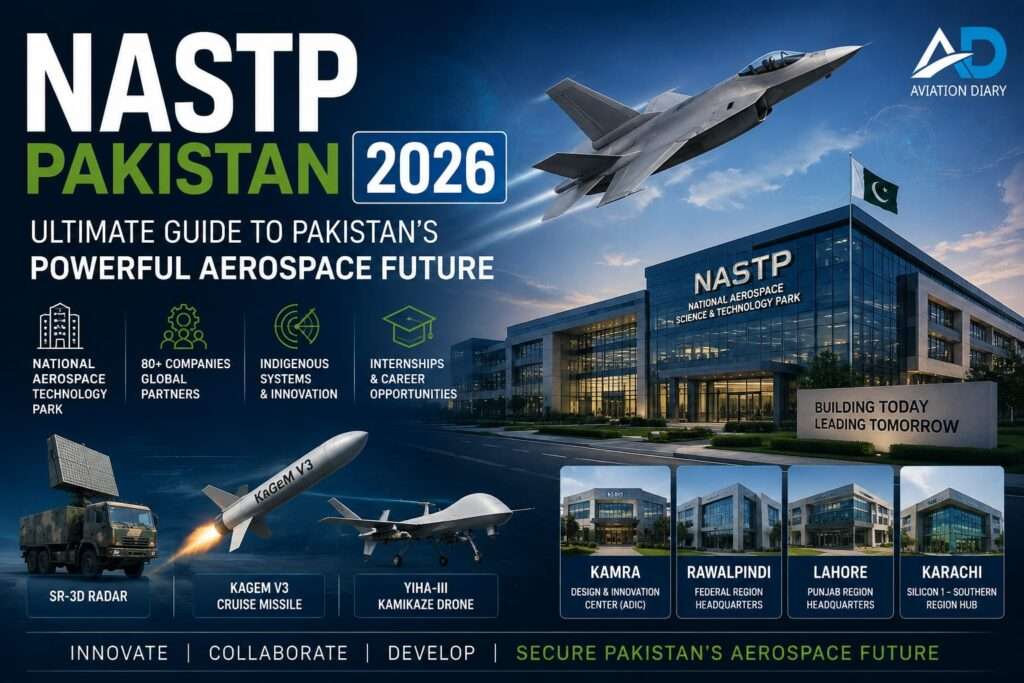
The flagship location is NASTP Kamra in Attock — the Aerospace Design and Innovation Center (ADIC). NASTP Kamra is one of the largest aerospace design centers in the region, a strategic enabler of Pakistan’s national fighter program (PFX), and hosts 50+ small to medium-size design and R&D companies across four buildings.
The southern hub is NASTP Silicon 1 in Karachi. Silicon 1 is located in Karachi and serves as the regional headquarters for the southern region of Pakistan, measuring 7 acres of land, 200,000 square feet of built-up area, and more than 125,000 square feet of rentable spaces.
Silicon 1 is home to major design and R&D setups of the Pakistan Air Force in simulator, AR, VR, robotics, space, wireless and communication systems, cyber, IT, computing and big data, software development, and artificial intelligence domains.
NASTP has also established regional headquarters in Rawalpindi for the federal region and Lahore for Punjab province.
This four-city physical presence makes NASTP Pakistan 2026 the most geographically distributed aerospace infrastructure project in the country’s history.
Who Is Inside NASTP Pakistan 2026
The tenant list at NASTP Pakistan 2026 is what separates it from every other government technology initiative in Pakistan—because it includes some of the most significant names in global defence and aerospace.
Turkish Aerospace Industries (TAI) established its inaugural office within the park—the first Turkish defence company to set up an office in Pakistan’s inaugural technopark. Baykar — maker of the Bayraktar TB2 drone — also opened an office in NASTP.
NASTP hosts an international enclave of 25 companies and 80+ private aerospace and IT companies.
The presence of TAI and Baykar inside NASTP Pakistan 2026 is not incidental. TAI is the manufacturer of the KAAN fifth-generation fighter jet and the primary partner in Pakistan’s own national fighter program—the PFX. Baykar’s TB2 drone has proven itself in multiple active conflict zones across the world.
Having both companies physically embedded within Pakistan’s aerospace technology park signals the depth of Turkey-Pakistan defence cooperation and the seriousness with which both sides are approaching co-development of future systems.
The President of Kyrgyzstan, Sadyr Zhaparov, visited NASTP in December 2025 as part of his official state visit to Pakistan, a signal of NASTP Pakistan 2026’s growing international profile beyond its immediate defence partnerships.
What NASTP Pakistan 2026 Has Already Built
NASTP Pakistan 2026 is not a future plan—it is an operational facility that has already delivered tangible defence products into Pakistan’s active inventory.
NASTP has developed various weapons and defence systems, including the KaGeM V3 cruise missile, the SR-3D Radar, and the YIHA-III kamikaze drone, often in collaboration with Turkish defence companies.
The radar program is particularly significant. Pakistan has deployed new indigenous AESA radars developed primarily through NASTP, including the long-range AM-350S, the mobile Machaan Ground Radar for Air Defence (GRAD), and the short-range SR-3D system.
These platforms form a layered, networked architecture that defence officials describe as a shift from reliance on legacy imported systems to domestically produced sensors with enhanced mobility and electronic counter-countermeasure features.
The AM-350S is an S-band GaN-based AESA radar with a claimed maximum detection range of 350 kilometres and altitude coverage up to 60,000 feet. The SR-3D operates at 30 RPM for a 2-second refresh rate with an 80 km range suited for terminal engagement zones—and a longer-range variant targeting 160 km is under development for late 2026.
These are not prototype systems sitting in a laboratory. They are deployed, operational defence assets developed under the NASTP Pakistan 2026 ecosystem—a direct demonstration that Pakistan’s aerospace technology park is delivering on its strategic mandate.
NASTP Pakistan 2026 and the National Fighter Program (PFX)
The single most consequential project connected to NASTP Pakistan 2026 is the Pakistan Fighter Experimental — the PFX program.
Pakistan’s national fighter program is the PAF’s long-term ambition to develop an indigenous next-generation combat aircraft, reducing dependence on foreign platforms and building sovereign aerospace manufacturing capability. NASTP Kamra’s designation as a strategic enabler of the PFX program means the technology cluster is directly feeding into the design, engineering, and systems development work that will eventually produce Pakistan’s own fighter jet.
This context matters for anyone following the PAF’s fleet modernization—including the recently announced J-35 acquisition. Aviation Diary’s coverage of Pakistan’s evolving air power strategy sits alongside the NASTP Pakistan 2026 story as two parallel tracks of the same national aerospace ambition: procure advanced foreign platforms in the short term while building the domestic capability to design and manufacture them independently over the long term.
NASTP Pakistan 2026 Internship and Career Opportunities
NASTP Pakistan 2026 is not exclusively a defence and industry platform. It has a structured talent pipeline through its internship and hiring programs—making it directly relevant to aviation and aerospace students across Pakistan.
The NASTP Summer Internship Program 2026 offers placements across 9 major technology domains: Aerospace Engineering, IT/Software, Cybersecurity, AI/ML, Space Technology, Radar/Wireless, Innovation/Incubation (NICAT), Aviation Training/Certification, and Policy/Strategic Studies.
The program is open to Pakistani university students from their second year onward and recent graduates from HEC-recognized institutions, with a duration of 6 to 8 weeks and a monthly stipend provided.
For students targeting aviation careers in Pakistan, the Aviation Training and Certification domain at NASTP Pakistan 2026 is worth particular attention—it provides direct exposure to PCAA-recognized certification processes and connects interns with Pakistan’s civil aviation regulatory ecosystem.
This connects directly to the broader career pathways Aviation Diary covers in depth. If you are mapping a route into Pakistan’s aviation industry—whether through pilot training, CPL or ATPL licensing, or understanding pilot training costs in Pakistan 2026 — NASTP Pakistan 2026’s internship track offers a parallel entry point into the aerospace sector that few students are currently aware of.
For those considering air traffic control careers in Pakistan, the Radar and Wireless domain at NASTP Pakistan 2026 provides technical exposure to the exact systems that underpin Pakistan’s air defence and civil aviation surveillance infrastructure.
NASTP Pakistan 2026 and Civil Aviation’s Technology Future
NASTP Pakistan 2026’s mandate extends beyond military aerospace. The park’s vision is to become one of the best aerospace, cyber, and IT clusters in the world and transform the national landscape with design, R&D, and innovation centers for emerging and disruptive technologies.
The civil aviation implications are substantial. Pakistan’s rapidly expanding domestic airline sector—with PIA under new private ownership, South Air Pakistan launching regional operations, and passenger traffic at the busiest airports in Pakistan 2026 hitting record highs—requires a deeper domestic technology and engineering ecosystem to sustain it.
MRO (Maintenance, Repair, and Overhaul) capacity, avionics development, drone integration into civil airspace, and AI-driven air traffic management are all areas where NASTP Pakistan 2026’s capabilities intersect directly with civil aviation’s future needs.
The development of NASTP marks a pivotal leap, designed as a premier ecosystem for research, development, and innovation. It aims to foster collaboration between academia, industry, and the Pakistan Air Force and is poised to become a hub for aerospace technology, avionics, and drone development—creating a high-tech talent pipeline and attracting global aerospace firms.
Why NASTP Pakistan 2026 Is the Story Most People Are Missing
Pakistan’s aviation media covers airline launches, route announcements, and job postings. Almost nobody is covering NASTP Pakistan 2026 with the depth it deserves—and that is exactly why Aviation Diary is covering it now.
The park represents Pakistan’s clearest articulation of what aerospace self-reliance actually looks like in practice. It is not a policy document or a five-year plan. It is a functioning cluster of 80+ companies, two deployed radar systems, an operational kamikaze drone, a cruise missile program, Turkey’s top two defence companies, and an internship pipeline feeding fresh engineering talent into the ecosystem every year.
For Pakistan’s aviation industry — military and civil alike — NASTP Pakistan 2026 is the foundation being laid beneath everything else that is growing above it.
Final Word on NASTP Pakistan 2026
NASTP Pakistan 2026 is Pakistan’s most serious attempt to build genuine aerospace sovereignty—and by the evidence of what it has already produced, it is working. The SR-3D radar is deployed. The KaGeM V3 cruise missile exists. The YIHA-III kamikaze drone is operational. TAI and Baykar are physically on-site. The PFX national fighter program has a dedicated design center at Kamra.
None of this happened by accident. NASTP Pakistan 2026 is the result of a deliberate, PAF-led strategy to use a technology park as the engine of national aerospace capability—and the results are already visible in Pakistan’s active defence inventory.
Aviation Diary will continue tracking NASTP Pakistan 2026 developments — from new product unveilings to career opportunities and international partnerships. Bookmark aviationdiary.com for Pakistan’s most complete aerospace coverage.
Subscribe to Aviation Diary’s newsletter — Pakistan aviation news, military aerospace updates, and career guides delivered straight to your inbox.
Aviation Diary Editorial
editor@aviationdiary.com

Your Window to the World Above!