
Let me be straightforward with you before we begin.
This is not a paid review. Fly Jinnah did not sponsor this post, offer us free tickets, or send us a gift basket of promotional material. This is AviationDiary — and the whole point of this blog is to tell you what the experience is actually like, not what the airline’s marketing department wishes it were.
With that said, let us talk about Fly Jinnah honest review 2026.
Pakistan’s youngest mainstream carrier – a joint venture between the Lakson Group and the Air Arabia Group – has been the most talked-about airline in Pakistan since it launched domestic operations in November 2022. In less than four years, it has gone from a three-aircraft startup to one of the most booked domestic carriers in the country, with Momondo data showing it accounts for a remarkable 57% of Karachi to Islamabad bookings.
That kind of growth deserves a serious, honest look. So here is ours.
1. Booking Experience and Pricing vs PIA and Airblue
The first thing you notice about FlyJinnah is that it operates like a proper low-cost carrier — which means the headline price looks very attractive, but the total price depends heavily on what you add.
The Base Fares
On the popular Karachi–Islamabad route in 2026, Fly Jinnah’s fares typically start around PKR 20,000–24,000 one way with checked baggage included. For comparison, PIA on the same route runs around PKR 20,310, and Airblue can go as low as PKR 17,175 when you catch a deal. On the Karachi–Lahore sector, the market is similarly competitive.
So Fly Jinnah is not always the cheapest — Airblue often undercuts it on flash sales. What Fly Jinnah consistently offers is fare predictability and a straightforward booking experience.
The Booking Website and App
The website is clean, loads quickly, and does not bombard you with confusing upsells the way some budget carriers do internationally. You can book in a few clicks via credit card, JazzCash, or Easypaisa — which is genuinely convenient for passengers who do not have a credit card.
The Fly Jinnah app is functional. You can check in online, access your boarding pass, and monitor flight status. It is not the most sophisticated aviation app in the world, but it does what it needs to.
The Baggage Trap — Read This Carefully
Here is where Fly Jinnah, like every low-cost carrier, requires your attention. The basic fare includes only a 10kg carry-on. If you have checked luggage, you need to pre-book it. The tiers are:
- 23kg: reasonable pre-booked rate
- 30kg (2 bags): mid-tier add-on
- 46kg (2 bags): family travel option
The critical warning: if you show up at the airport without pre-booking your baggage, the airport rate is dramatically higher — some passengers have reported paying nearly three times the online rate. One reviewer noted paying PKR 3,800 per bag at the airport when it was PKR 1,300 online. This is not unique to Fly Jinnah – it is how every low-cost carrier in the world works – but in Pakistan, where many passengers are flying budget for the first time, it catches people off guard regularly.
Our verdict on booking: Pre-book everything online at least 24 hours before departure and your total cost will be competitive. Leave it to the airport and you will regret it.
2. Check-In and Boarding at Karachi, Lahore, and Islamabad
Web Check-In
Online check-in opens 24 hours before departure and closes 4 hours before. If you use it – and you should – you can skip the long check-in queues at the airport and head straight to bag drop if you have checked luggage or directly to security if you are travelling hand-carry only. This alone makes Fly Jinnah smoother than PIA for most domestic passengers.
At Karachi (Jinnah International)
Karachi is Fly Jinnah’s home base, and it shows. The check-in counters are generally well-staffed. The dedicated Fly Jinnah counters are open two hours before departure. During peak times — morning rush, Friday evenings, and Eid travel — queues can build up. Some passengers have reported two-hour check-in lines during very busy periods, though this appears to be an exception rather than the norm on ordinary travel days.
Gate information at Karachi can sometimes be delayed. Make sure your phone notifications are on for the Fly Jinnah app so you are not the person who misses the boarding call.
At Lahore (Allama Iqbal International)
The experience in Lahore is largely similar. One thing worth noting: boarding is sometimes done by bus at Lahore, particularly for early morning flights. In winter, this means standing on a cold tarmac at 5am while waiting to board. It is not ideal, but it is an airport infrastructure issue rather than a Fly Jinnah one — most domestic carriers face the same constraint.
At Islamabad (Islamabad International)
Islamabad International is one of Pakistan’s newest and best-maintained airports, and the experience here tends to be the smoothest of the three major hubs. Fly Jinnah benefits from the modern terminal layout. Gate announcements are generally timely.
Overall Boarding Assessment
Boarding is typically done by zone and is reasonably orderly by Pakistani aviation standards. Fly Jinnah staff are trained to enforce boarding discipline, which reduces the chaotic rushing that passengers from other airlines will recognise. The process is not Emirates-level smooth, but it is meaningfully better than the boarding experience on domestic PIA flights on an average day.
3. Cabin Comfort: Legroom, Seats, and Cleanliness
This is where Fly Jinnah has a genuine, documented advantage over much of the competition — and it is worth explaining why.
The Aircraft.
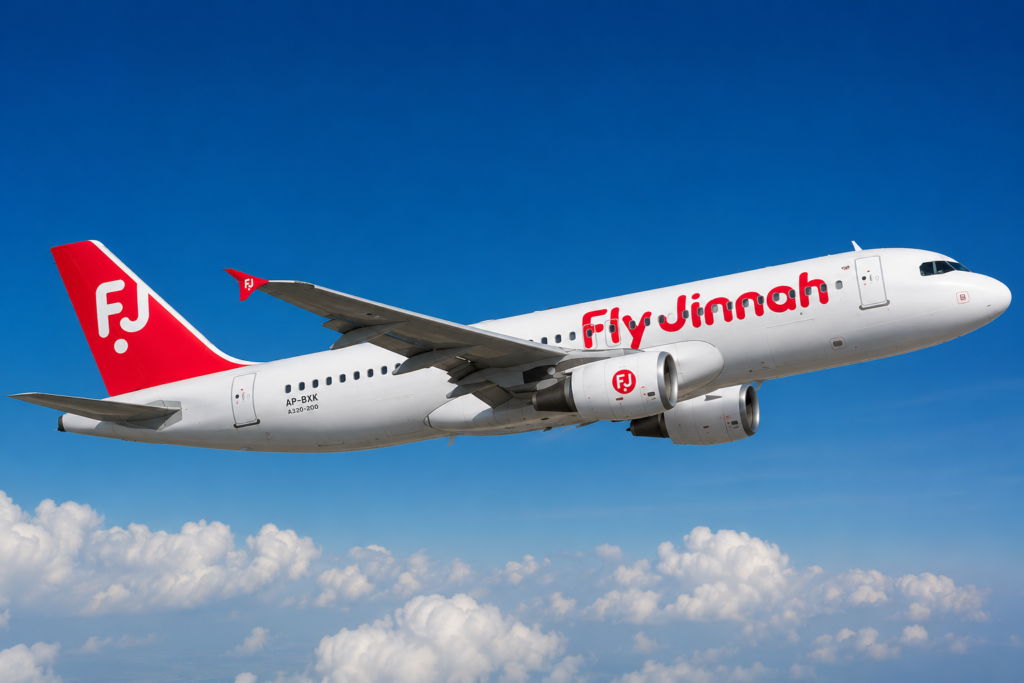
Fly Jinnah operates an all-Airbus A320-200 fleet, configured in a 3-3 layout with 174 economy seats. The fleet average age is around 10–12 years, which is relatively modern for Pakistan’s domestic market. All aircraft are powered by CFM56 engines. By 2026 the airline is expanding to 12 aircraft, all maintaining this consistent A320 standard.
Legroom — Fly Jinnah’s Proudest Claim
Fly Jinnah markets itself as offering “the largest economy class legroom” in Pakistan’s domestic market, and this is not just marketing fluff. Because they configure the A320 with 174 seats rather than the more common 180–186 seat-dense configurations used by some competitors, there is genuinely more seat pitch. For a country where a significant portion of the male population is tall, this matters.
If you have ever sat in a densely configured domestic flight and felt like your knees were in the seat in front of you, Fly Jinnah’s cabin will feel noticeably more comfortable.
Seat Quality
The seats are modern, the upholstery is in good condition, and the cabin is clean. These are relatively new aircraft, and Fly Jinnah’s cabin crew maintain cleanliness standards that are noticeably better than what you might find on an older PIA domestic aircraft. Seatback tables work. Overhead bins close properly.
Entertainment — SkyTime
Fly Jinnah offers SkyTime, a complimentary in-flight streaming service accessed on your own device. The library includes Hollywood, Bollywood, Arabic and local content, along with music, audiobooks and games. However, multiple passenger reviews note that the SkyTime WiFi is frequently unavailable or unstable mid-flight. When it works, it is a great value-add. When it does not, which is often, it is genuinely frustrating for a two-hour domestic flight.
Meals
As a low-cost carrier, meals are not included in the basic fare. The value fare includes a sandwich and water. Additional snacks and beverages can be purchased on board. Options are limited — do not board expecting a hot meal. For a domestic flight that is under two hours at most, this is acceptable.
Cabin Comfort Verdict: Better legroom and cleaner aircraft than much of the competition. The SkyTime reliability issue is a real frustration that Fly Jinnah needs to fix.
4. Crew Service — Friendly or Robotic?
This is the most subjective section of any airline review, and Fly Jinnah’s crew get a genuinely mixed verdict from Pakistani passengers.
What the Reviews Say
Positive passenger experiences consistently mention crew who are courteous, professional, and helpful — particularly on international routes to the Gulf. Several reviewers specifically name individual crew members who went out of their way, which speaks to a culture where good service is noticed and recognised.
On the other hand, a meaningful number of negative reviews describe crew who were dismissive or unhelpful — particularly at check-in desks rather than in the cabin. The baggage dispute situation (where airport staff charge significantly more than the online rate) has put check-in staff in an uncomfortable position where they are enforcing a policy that even they disagree with internally.
The Aviation Diary Assessment
From an aviation perspective, Fly Jinnah’s crew are trained to an Air Arabia standard, which is a genuinely professional baseline. The cabin crew on most flights is young, well-groomed, and follows safety procedures correctly and without shortcuts. This matters more than most passengers realise.
Where the service falls slightly short is in the warmth and personalisation that you might experience with SereneAir, which positions itself at the premium end of Pakistan’s private carrier market. Fly Jinnah’s crew service is efficient and professional, but it has the slightly transactional feel of a low-cost carrier that is moving a lot of passengers through a lot of flights every day.
Is it robotic? Not quite. Is it warm and memorable? Not particularly either. It sits comfortably in the middle — competent and professional, which for a domestic budget flight is genuinely all most passengers need.
5. On-Time Performance — From Personal Experience
This is where Fly Jinnah makes its strongest case.
The PCAA Data
According to Pakistan Civil Aviation Authority performance reports for the January–June 2025 period — the most recent benchmark data available — Fly Jinnah ranked second overall for punctuality among domestic carriers with a 59.79% on-time rate, while topping the rankings for regularity (lowest cancellation rate) at 95.46%.
To put that in context: cancellations are extraordinarily rare on Fly Jinnah. When they do have a delay, it is usually not a cancellation — the flight runs, just late. And in the Pakistani aviation context, where weather disruptions, ATC congestion, and ground handling issues affect every carrier, a near-95% regularity rate is impressive.
The Honest Picture on Delays
Where Fly Jinnah is not perfect is in delayed communication. Several passengers — including a review from as recently as May 2026 — describe experiencing cascading delays on the same flight with little proactive communication from the airline: a flight moved from 8:30pm to 10:10pm, then to midnight, then to 1:40am with no explanation. This kind of experience, while not the norm, does happen — and Fly Jinnah’s proactive communication to passengers during disruptions is an area that needs improvement.
The overall picture, however, is positive. For the majority of flights on the majority of days, Fly Jinnah departs within a reasonable window of its scheduled time. Compared to PIA’s domestic punctuality record, it is a meaningful improvement.
International Route Note
For international routes – Sharjah, Jeddah, Dammam, Bahrain – passenger reviews are more mixed. The Bahrain–Islamabad route in particular has seen boarding and departure complaints as recently as May 2026. International operations appear to be less consistent than domestic ones, possibly reflecting the growing pains of a carrier still scaling its international network.
6. Verdict — When to Choose Fly Jinnah and When to Avoid It
After going through every dimension of the experience, here is our honest, considered verdict for 2026:
✅ Choose Fly Jinnah When:
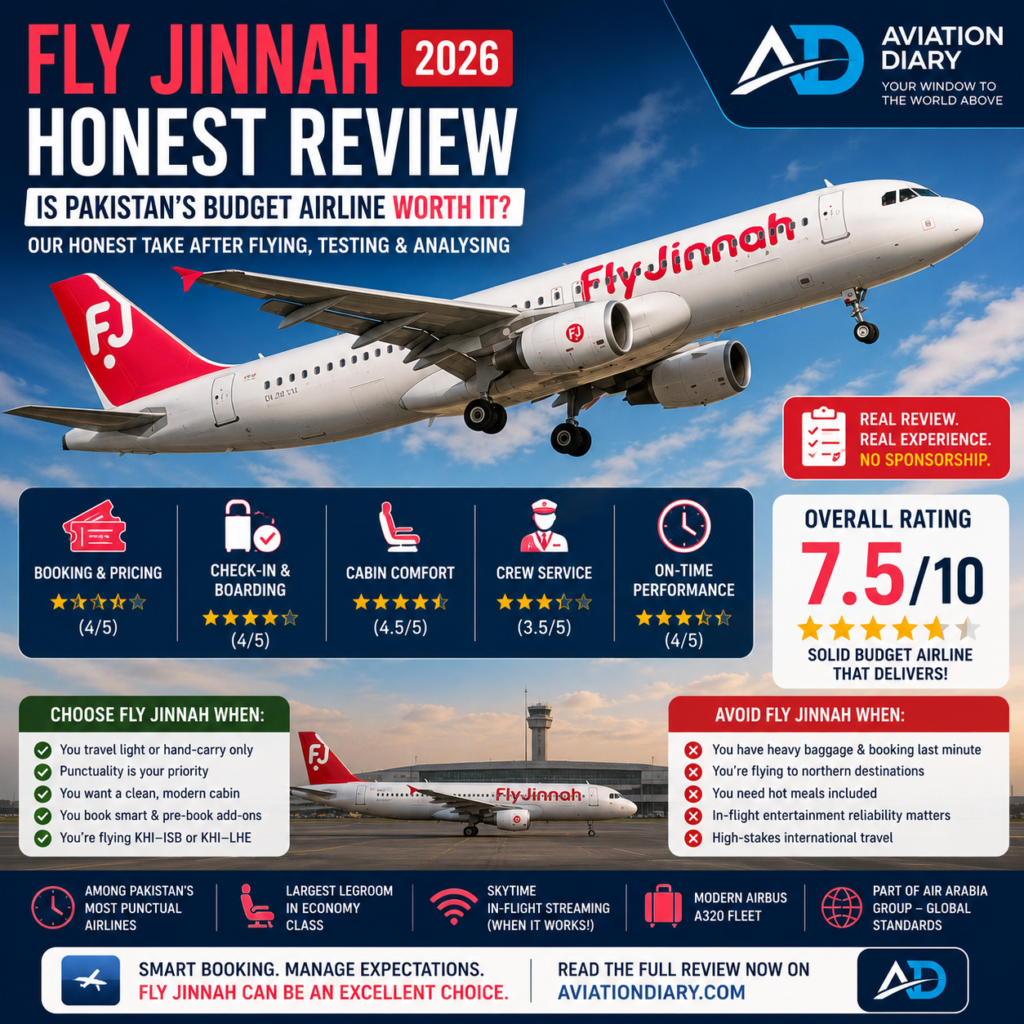
You are travelling light or hand-carry only. This is where Fly Jinnah absolutely shines. Pre-book a seat, check in online, head straight through security, board promptly. It is the most friction-free domestic travel experience in Pakistan for carry-on-only passengers.
Punctuality is your priority. For a business trip, a connecting flight, or a family event with a strict schedule — Fly Jinnah’s regularity rate makes it the most reliable option on core domestic routes.
You want a clean, modern cabin. The aircraft are newer and better maintained than much of PIA’s domestic fleet. The extra legroom is a real advantage.
You are on a budget and book smart. Pre-book your baggage online, select your seat during booking, and Fly Jinnah’s total cost is genuinely competitive — sometimes the best available.
You are flying the Karachi–Islamabad or Karachi–Lahore triangle. These are Fly Jinnah’s strongest routes with the highest frequency and the most consistent experience.
Avoid Fly Jinnah When:
You have significant checked baggage and are booking last minute. The airport baggage rate is punishing. If you cannot book at least a day ahead to secure the online baggage rate, you may be better served by a full-service carrier where baggage is included.
You are flying to a remote northern destination. Gilgit, Skardu, Chitral — Fly Jinnah does not operate to these routes. PIA remains your only scheduled carrier option for northern Pakistan.
You need a hot meal included. On a short domestic hop this should not matter, but if you are flying hungry and counting on an included meal, Fly Jinnah’s Basic fare will disappoint you.
The reliability of in-flight entertainment matters to you. If SkyTime being down would ruin your flight, set your expectations low or download your own content.
You are flying international and the stakes are high. On domestic routes, the experience is well-established. For Fly Jinnah’s international routes, there is enough variability in passenger reviews that we would suggest booking PIA or a Gulf carrier for high-stakes international travel until Fly Jinnah’s international operations mature further.
The Bottom Line
Fly Jinnah in 2026 is exactly what it set out to be: a clean, punctual, affordable low-cost carrier that works best when you engage with it on its own terms. Be book smart, travel light, and it will treat you well. Try to use it like a full-service airline with last-minute bookings and unchecked baggage expectations, and you will come away frustrated.
For the vast majority of Pakistani domestic travellers making routine trips between Karachi, Lahore, and Islamabad, Fly Jinnah is genuinely excellent value and, on balance, a better experience than PIA’s domestic operation on most days.
Is it worth it? Yes — with the caveat that “worth it” means understanding what kind of airline it is and booking accordingly.
We rate Fly Jinnah 7.5 out of 10 for domestic travel in 2026. A solid, well-run low-cost carrier that is still ironing out a few edges — but one that has earned its place as Pakistan’s most booked budget airline.
Frequently Asked Questions
Is Fly Jinnah safe to fly? Yes. Fly Jinnah holds a valid air operator’s certificate from the Pakistan Civil Aviation Authority (PCAA) and operates a modern Airbus A320 fleet. It is a joint venture with Air Arabia, one of the most established budget carriers in the Middle East, and follows Air Arabia’s safety standards.
Is Fly Jinnah cheaper than the PIA? Sometimes, but not always. On the Karachi–Islamabad route, fares are broadly similar. Fly Jinnah’s total cost can be lower if you travel hand-carry only, but once you add checked baggage, the prices are competitive rather than dramatically cheaper.
Does Fly Jinnah serve food on domestic flights? Free meals are not included in the basic fare. The value fare includes a sandwich and water. Additional snacks and drinks are available for purchase on board.
Can I check in online with Fly Jinnah? Yes. Online check-in opens 24 hours before departure via the website or app and is strongly recommended. It saves time at the airport and lets you choose your seat.
How does Fly Jinnah compare to Airblue? For pure punctuality and modern cabin comfort, Fly Jinnah is competitive with Airblue. Airblue has a longer track record and is often slightly cheaper on flash sales. Airblue also includes more services by default (baggage inclusions vary by fare). For hand-carry-only travel, Fly Jinnah and Airblue are very similar. For family travel with heavy luggage, compare total costs carefully before booking.
Does Fly Jinnah fly to northern Pakistan (Gilgit, Skardu)? No. Fly Jinnah does not currently operate to northern Pakistan’s mountain airports. PIA is the primary scheduled carrier on these routes.
Have you flown with Fly Jinnah recently? Share your experience in the comments below — the good, the bad, and the delayed. We read every comment and frequently update our reviews based on what the community reports.
Fly safe.