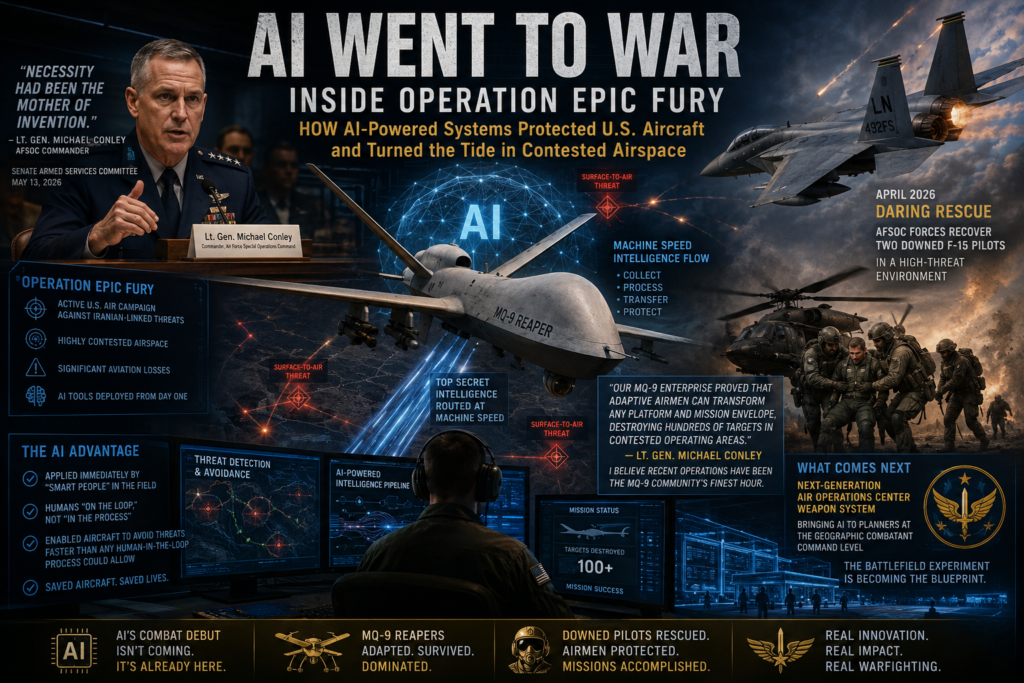

War has always been the forge of invention. But rarely do we get a window into exactly how — and when — technology turned the tide. On May 13, 2026, that window cracked open when Lt Gen. Michael Conley, head of Air Force Special Operations Command (AFSOC), told the U.S. Senate Armed Services Committee something extraordinary: an AI-powered system had been quietly protecting American aircraft in Operation Epic Fury since day one.
“Necessity had been the mother of invention,” Conley told senators. And in this case, necessity looked like dozens of MQ-9 Reaper drones flying into one of the most hostile air-space environments on Earth.
What Is Operation Epic Fury?
Operation Epic Fury is the U.S. military’s active air campaign conducted in a contested environment against Iranian-linked threats. Details remain classified, but what Conley revealed to the Senate committee offers an unprecedented look at how the US Air Force is fighting – and adapting – in real time.
The operation has seen significant aviation losses, as Conley acknowledged. But it has also become the proving ground for tools that were, until recently, experimental.
The AI That Went to War
On the very first day of Epic Fury, commanders realised their MQ-9 Reapers were in serious danger. Flying in what Conley described as a “very hostile environment”, the drones faced Iranian threats capable of targeting them before operators could react through traditional intelligence pipelines.
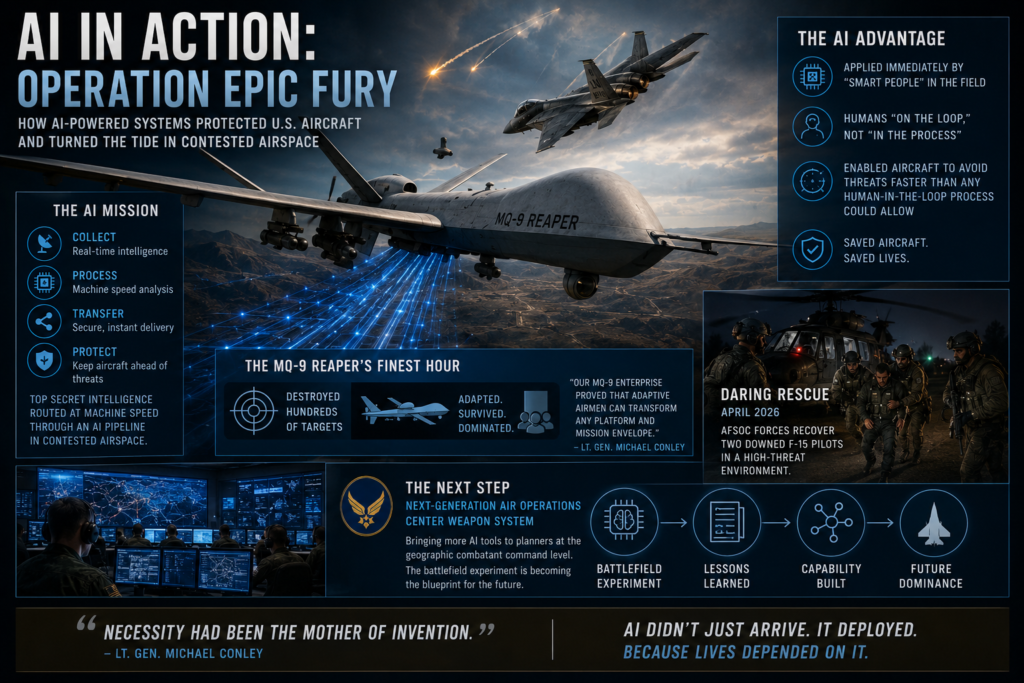
The AI system was used to collect intelligence and transfer it at machine speed, enabling aircraft to avoid threats faster than any human-in-the-loop process could allow. Conley described it as moving humans “on the loop instead of in the process the whole time” — a subtle but critical distinction that separates reactive defence from proactive survival.
The solution? Machine learning tools are applied immediately, in the field, by – as Conley put it – “smart people”.
The intelligence being moved was top-secret, national-level data. The fact that it was being routed through an AI pipeline in a live combat environment marks a significant shift in how the U.S. military thinks about classified information flow under fire.
The MQ-9’s Finest Hour
General Conley was emphatic in his praise for the Reaper fleet’s performance in Epic Fury.
“Our MQ-9 enterprise proved that adaptive airmen can transform any platform and mission envelope, destroying hundreds of targets in contested operating areas,” he said. “I believe recent operations have been the MQ-9 community’s finest hour.”
That’s a remarkable statement for a platform that has faced criticism in recent years for its vulnerability in contested airspace. The MQ-9 Reaper was designed for operations against low-tech adversaries — counterterrorism missions in Afghanistan and Iraq where air defences were minimal. Iran is a different problem entirely.
That the Reaper community adapted, in part through AI, to survive and succeed against a near-peer adversary’s air defence network is a story that will shape procurement decisions, doctrine, and training for years.
Rescuing Downed Pilots: AFSOC’s Other Headline
The AI story wasn’t Conley’s only revelation. He also highlighted a daring joint rescue operation in April 2026 in which AFSOC forces recovered two downed F-15 pilots – a mission that was widely praised across military circles.
The details of how those pilots were downed and subsequently rescued remain sparse, but the operation underscores the dual nature of AFSOC’s role in Epic Fury: not just strike and surveillance, but personnel recovery in an extremely hot threat environment.
What Comes Next: The Next-Gen Air Operations Center
The AI success in Epic Fury isn’t going unnoticed at the institutional level. The U.S. Air Force has already released contracting documents for a “Next-Generation Air Operations Center Weapon System”—a programme designed to bring more AI tools to planners at the geographic combatant command level.
No procurement timeline has been specified yet, but the direction is clear: the battlefield experiment has become the blueprint. What worked in Epic Fury will be codified, expanded, and embedded into future air operations planning infrastructure.
This is how military technology evolution actually happens. Not in boardrooms or congressional hearings, but under fire, when lives and aircraft are on the line and someone with a laptop and a machine learning toolkit makes a call that changes the outcome.
The Bigger Picture: AI’s Combat Debut in Operation Epic Fury
Military analysts have long theorised about the role AI would play in next-generation air combat. What Operation Epic Fury has revealed — however partially — is that AI’s debut isn’t coming. It’s already happened.
It didn’t arrive with a fanfare or a press release. It arrived on the first day of a combat operation, quietly, because lives depended on it.
The MQ-9’s performance, the rescued F-15 pilots, and the top-secret intelligence flowing at machine speed through an AI pipeline in contested airspace — these are the early chapters of a story that will define military aviation for decades.
Aviation Diary will continue tracking Operation Epic Fury and the evolution of AI in military aerospace as more details emerge.