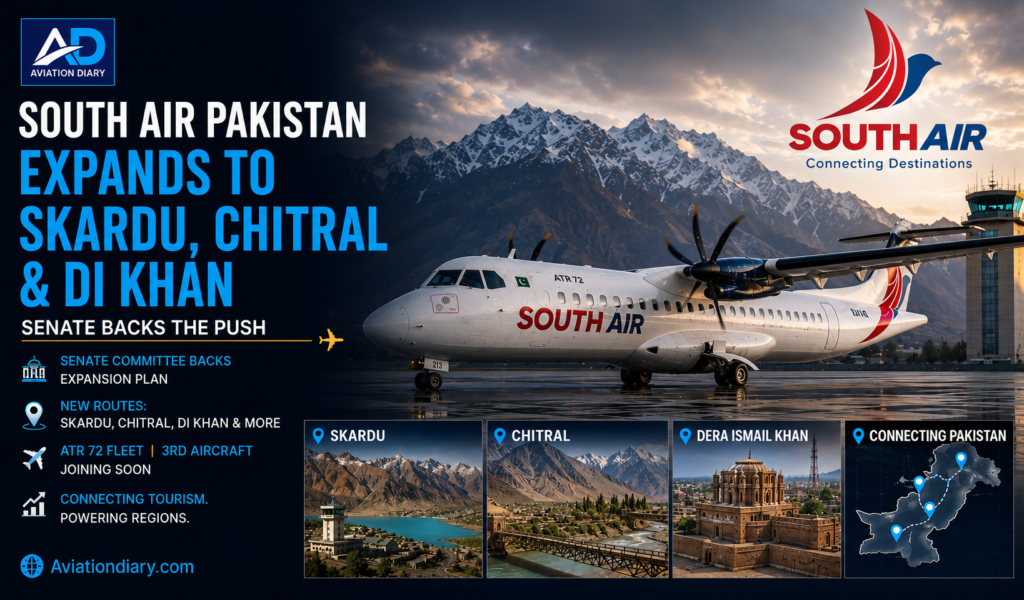

South Air Pakistan, the country’s newest regional carrier, is making bold moves just months into its operations. As Aviation Diary has been tracking Pakistan’s rapidly shifting domestic aviation landscape, this story stands out—a startup airline that launched on southern routes is now pushing hard into Pakistan’s most lucrative northern tourism corridors, and it has the Senate Standing Committee on Defense behind it.
What Is South Air Pakistan?
South Air Pakistan is a private regional airline headquartered in Karachi, operating under the Tourism Promotion and Regional Integration (TPRI) licensing framework issued by the Pakistan Civil Aviation Authority (PCAA). It is a subsidiary of SOS Group, commenced operations in November 2025 with a service on the Karachi–Multan route, and operates ATR 72 turboprop aircraft on domestic routes across Sindh, Balochistan, South Punjab, and Khyber Pakhtunkhwa. Wikipedia
South Air Pakistan entered the market with a specific mandate: connect underserved, low-traffic cities that larger carriers like PIA and AirBlue have historically ignored. The airline arrived under the TPRI project, which aims to promote tourism and improve regional integration through expanded air connectivity. Profit by Pakistan Today
South Air Pakistan’s Northern Route Push
Here is where things get interesting. South Air Pakistan was originally approved to serve neglected southern destinations—Gwadar, Panjgur, Nawabshah, and Sukkur. Aviation officials argued that South Air had secured fast-track approvals after promising to improve air connectivity in neglected regions of southern Pakistan. However, lawmakers ultimately backed the airline’s expansion strategy, saying regional carriers should be free to operate wherever demand exists.
South Air Deputy CEO Mohsin Jamil told the Senate committee that the airline currently operates two ATR-72 aircraft under wet-lease agreements and plans to add a third aircraft to its fleet. He said restrictions on foreign flight crews have affected operations to some destinations in Balochistan, leading the airline to operate services on northern routes as well.
That is a candid admission. South Air Pakistan is not abandoning the south—it is navigating real operational constraints while simultaneously chasing demand in the north.
Senate Committee Backs South Air Pakistan
Pakistan’s Senate Standing Committee on Defense backed South Air’s expansion to northern destinations, dismissing objections from aviation authorities that the airline had been licensed only to serve underserved southern regions.
Committee Chairman Senator Talha Mahmood supported the airline’s plan to operate flights to northern destinations, especially Chitral, which he said has long been neglected by carriers. Senator Farooq H. Naik argued that just as American Airlines does not operate only in America, South Air should not be restricted to the South by its name alone.
That analogy, while simplistic, landed. The committee closed the debate in South Air, Pakistan’s favor.
Routes on the Table: Skardu, Chitral, DI Khan, and More
South Air Pakistan expects to launch commercial flights to Chitral and Skardu by the end of June, subject to final regulatory approvals.
South Air Chairman Kanwar Muhammad Tariq confirmed plans for daily flights to Dera Ismail Khan, describing the city as an important destination. He also confirmed regular Chitral services, with the broader objective of linking small and remote areas to Pakistan’s air transport network. The airline additionally plans to operate flights from Peshawar to Karachi and Quetta, alongside daily services between Peshawar and Lahore.
KP Governor Faisal Karim Kundi welcomed the South Air Pakistan initiative, calling DI Khan a very important station and assuring the airline of every possible cooperation for launching flights to both Dera Ismail Khan and Chitral.
South Air Pakistan is not just filling gaps—it is building what could become a genuine regional network from scratch.
What This Means for Pakistan’s Domestic Aviation Market
South Air Pakistan’s expansion is significant for several reasons.
First, Skardu and Chitral are high-demand tourist destinations that remain chronically underserved in peak season. PIA operates limited flights, slots fill fast, and fares spike. A second carrier on these routes would create real competition and bring prices down.
Second, South Air Pakistan’s ATR 72 turboprop is the right aircraft for these routes—short runways, high altitudes, and thin traffic demand a smaller, efficient aircraft rather than a narrowbody jet. The aircraft fit is correct.
Third, Defense Secretary Muhammad Ali emphasized that Pakistan urgently needs reliable regional airlines to connect cities that remain underserved by major carriers. That statement from a serving official signals government-level intent to support South Air Pakistan rather than clip its wings.
The regulatory concern is legitimate—South Air Pakistan was approved on a specific mandate and is now broadening that mandate. Aviation authorities are right to flag it. But the Senate’s backing effectively settles the political question for now.
South Air Pakistan: Current Fleet and Operations
South Air Pakistan currently operates two ATR 72-500 aircraft under wet-lease arrangements. One aircraft is operating northern routes between Islamabad, Gilgit, and Chitral, while the other continues serving Balochistan routes, including the Karachi–Gwadar corridor. A third aircraft addition is in the pipeline.
South Air Pakistan’s rapid induction of multiple aircraft indicates the airline intends to begin operations with meaningful schedule reliability and route coverage from the outset.
For a startup regional carrier, that is an aggressive but necessary posture. Thin-frequency operations kill passenger confidence early.
Bottom Line
South Air Pakistan is the most active story in Pakistan’s domestic aviation sector right now. It has Senate support, a growing fleet, and a route map that covers the country from Gwadar to Gilgit. The regulatory tension with PCAA over its original southern mandate is a real issue, but it has not slowed the airline down.
Flights to Skardu, Chitral, and DI Khan are expected before the end of June 2026. If South Air Pakistan delivers on that timeline—and secures its third aircraft—it will have built a credible regional network in under a year. That is worth watching closely.
Aviation Diary will continue covering South Air Pakistan’s route launches and fleet developments as they happen.
Aviation Diary Editorial editor@aviationdiary.com AviationDiary.com

Your Window to the World Above!