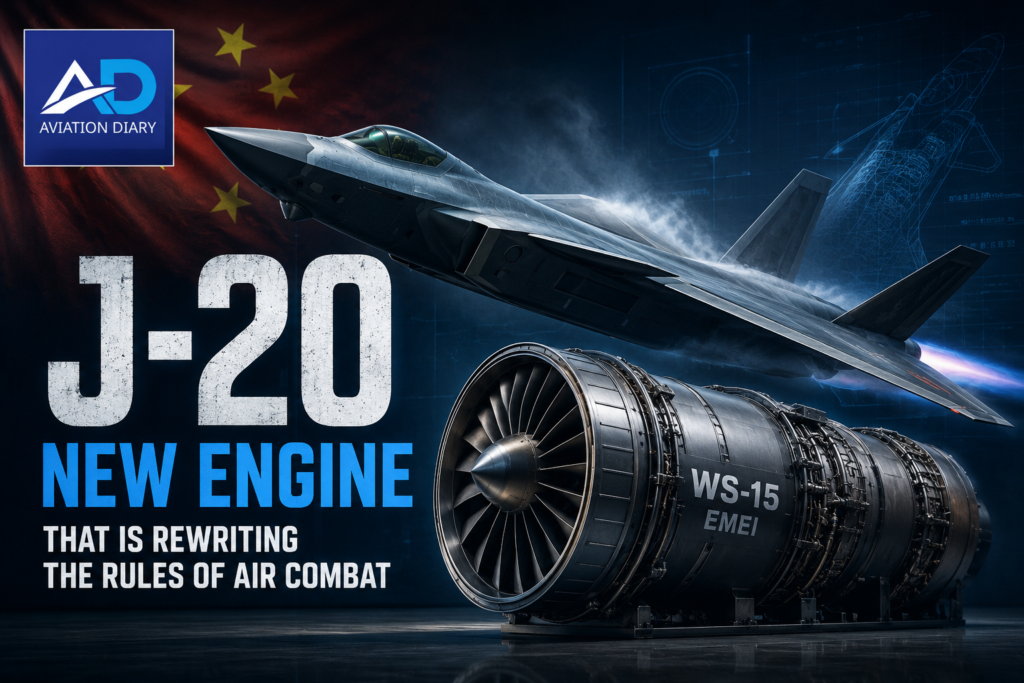

The J-20 New Engine That Is Rewriting the Rules of Air Combat
For years, the Chengdu J-20 “Mighty Dragon” was a stealth fighter living on borrowed time — built for fifth-generation performance but shackled to engines never designed to deliver it. That era is now over. The WS-15 turbofan engine, codenamed “Emei”, has entered serial production and operational service, giving the J-20 its true heartbeat for the first time since the program began — as reported and analyzed in depth by Aviation Diary.
The WS-15 turbofan engine is developed by the Shenyang Aeroengine Research Institute and manufactured by the Shenyang Liming Aircraft Engine Company under the Aero Engine Corporation of China (AECC). It is an afterburning, low-bypass turbofan engineered from the ground up to power China’s most advanced combat aircraft and challenge the dominance of Western fifth-generation propulsion systems such as the Pratt & Whitney F119 powering the F-22 Raptor.
The arrival of the J-20 new engine is not merely a hardware upgrade — it is a strategic inflection point that reshapes China’s air power posture across the Indo-Pacific and signals the maturation of an indigenous aerospace industry that once lagged two generations behind its rivals.
Origins of the WS-15 Turbofan Engine: A Three-Decade Journey
Born in the Early 1990s
Development of the WS-15 turbofan engine began in the early 1990s, conceived as a clean-sheet design intended to leapfrog the limitations of China’s existing jet engine technology. While the WS-10 Taihang was a heavily improved derivative of an older fourth-generation design, the WS-15 turbofan engine was designed from scratch as a purpose-built next-generation propulsion system for heavy fifth-generation fighters — placing it in the same conceptual bracket as America’s F119 from the very outset.
By 2005, the engine had completed successful testbed runs. An image of the core made its public debut at the 2006 China International Aviation & Aerospace Exhibition in Zhuhai — the world’s first glimpse of China’s most ambitious propulsion program.
The Silent Years: Overcoming Technological Barriers
The path to putting the WS-15 turbofan engine into the J-20 was far from straightforward. For the better part of a decade, the program operated in near-total secrecy. China faced formidable gaps in critical technologies: thermal barrier coatings, single-crystal turbine blade manufacturing, high-temperature alloy production, and precision machining tolerances — all areas where Western aerospace manufacturers had a multi-decade head start. A public stumble on China’s flagship engine program would have been damaging, so progress was quiet and deliberate.
The WS-15 Turbofan Engine Breaks Through: Key Milestones
The 2020s brought a cascade of breakthroughs that culminated in the J-20 new engine reaching operational units:
- March 2022: Chinese state media confirmed the J-20 had flown trials with the WS-15 turbofan engine, reporting significantly improved performance over earlier powerplants.
- December 2022: Analysts noted a new J-20 prototype — painted in yellow test primer — at Chengdu facilities, believed to be evaluating the WS-15 turbofan engine alongside thrust-vectoring control (TVC) nozzles.
- March 2023: An AECC executive announced that serial production of the WS-15 turbofan engine had commenced and that China had “tackled all technical bottlenecks” with the program.
- June 2023: A J-20B equipped with dual WS-15 turbofan engines reportedly completed its maiden flight in Chengdu — a watershed moment for Chinese aerospace.
- December 2025: The first batch of serial-production J-20 stealth fighters equipped with twin WS-15 turbofan engines completed production, with the first operational flight confirmed on December 27, 2025.
WS-15 Turbofan Engine Specifications: What the J-20 New Engine Can Do
Core Technical Architecture
The WS-15 turbofan engine uses a low-bypass ratio afterburning architecture — the same configuration used in every high-performance fifth-generation fighter engine worldwide. This design prioritizes raw thrust and supersonic performance over fuel efficiency, making it the correct choice for an air superiority platform like the J-20. It sits in the same engine family as the American F119, F135, and Russia’s AL-41F.
| Specification | Details |
|---|---|
| Type | Afterburning low-bypass turbofan |
| Codename | Emei (峨眉) |
| Manufacturer | Shenyang Liming Aircraft Engine Company / AECC |
| Designer | Shenyang Aeroengine Research Institute |
| First Run | 2005 (testbed) |
| Primary Application | Chengdu J-20 (J-20A, J-20B, J-20S) |
| Estimated Dry Thrust | ~105–110 kN |
| Estimated Afterburner Thrust | ~180 kN (~40,000 lbf / 18,000 kgf) |
| Thrust-to-Weight Ratio | Estimated 10:1 to 11:1 |
| Status | Serial production, initial operational capability (2025) |
Official specifications remain classified. Figures above reflect open-source defense analyst estimates.
Thrust and Raw Power Output
The WS-15 turbofan engine is estimated to generate 18 to 20 metric tons of thrust, putting it on par with — or potentially exceeding — the Pratt & Whitney F119 that powers the F-22 Raptor. Early prototypes reportedly demonstrated at least 36,000 lbf of afterburning thrust, with the full production target set at 40,000 lbf (approximately 180 kN). Twin WS-15 turbofan engines on a J-20 would give it a combined thrust output greater than virtually any other tactical combat aircraft currently flying.
Compared to the WS-10C — the J-20’s previous interim engine with a thrust rating of 142–147 kN and a thrust-to-weight ratio near 9.5 — the WS-15 turbofan engine delivers a thrust-to-weight ratio of 10:1 to 11:1, a leap that translates directly into climb rate, acceleration, and sustained energy in combat maneuvering.
J-20 New Engine Unlocks Supercruise: A Fifth-Generation Game Changer
Perhaps the single most important operational capability the J-20 new engine delivers is supercruise — the ability to fly at supersonic speeds without engaging the afterburner. Supercruise is a defining benchmark of genuine fifth-generation performance: it allows the J-20 to rapidly close on targets, extend its combat radius significantly, and avoid the massive infrared signature generated by sustained afterburner use.
Neither the Russian AL-31FN nor the WS-10C could consistently deliver this capability. The WS-15 turbofan engine was designed from its inception to enable reliable, sustained supercruise, transforming the J-20 from an aircraft that occasionally exceeded Mach 1 cleanly into one that can operate supersonically as a matter of routine.
Single-Crystal Turbine Blades: The Material Science Behind the WS-15 Turbofan Engine
A crucial innovation enabling the WS-15 turbofan engine’s performance and durability is the use of single-crystal turbine blades. These are components manufactured by cooling molten metal in a controlled directional process so that the entire blade grows as one continuous crystal lattice — eliminating the grain boundaries where fatigue cracks typically initiate under the extreme heat and centrifugal stress of jet engine operation.
Producing single-crystal blades at the tolerances required for a high-performance military turbofan is one of the most technically demanding manufacturing processes in all of aerospace. China’s successful mastery of this technology — confirmed by AECC’s 2023 announcement that all material bottlenecks had been resolved — is a milestone that places China’s engine industry in genuinely elite global company.
The payoff: the WS-15 turbofan engine has a significantly longer service life and substantially lower maintenance burden than the WS-10C, both critical advantages in high-tempo operational environments.
Stealth, Thermal Management, and the WS-15 Turbofan Engine’s IR Signature
A fifth-generation engine must do more than generate thrust — it must do so while minimizing the aircraft’s detectability. The WS-15 turbofan engine incorporates advanced thermal barrier coatings on its hot-section components and features redesigned petal-type exhaust nozzles that reduce both radar cross-section and infrared signature from the rear aspect. These serrated, pointed nozzles represent a visible departure from earlier J-20 engine installations and are an immediate visual indicator that the aircraft is equipped with the WS-15 turbofan engine rather than its predecessors.
Thrust Vectoring Control (TVC): What the J-20 New Engine Could Add Next
The WS-15 turbofan engine is expected to eventually incorporate two- or three-dimensional thrust vectoring control (TVC) — the ability to physically deflect engine exhaust to produce pitch and yaw control moments beyond what aerodynamic surfaces alone can deliver. TVC dramatically enhances close-combat agility, particularly at low speeds and high angles of attack where conventional control surfaces lose effectiveness.
China demonstrated TVC technology on a WS-10-powered J-10B at the 2018 Zhuhai Airshow — a clear signal of its intent to integrate the technology into the broader WS engine family. The WS-15 turbofan engine’s revised nozzle geometry is consistent with TVC integration in future production variants.
Why the J-20 New Engine Changes Everything Strategically
The WS-15 Turbofan Engine Ends China’s Foreign Engine Dependency
From 2017 through approximately 2019, every operational J-20 flew on Russian Saturn AL-31F or AL-31FN engines — imports that were never suited to the J-20’s performance requirements and represented a profound strategic vulnerability. Russia could, in theory, restrict supply as a political tool, and the AL-31’s performance ceiling was incompatible with true fifth-generation operations.
The WS-10C reduced that dependency but did not eliminate the underlying problem: it was still a fourth-generation engine bloodline trying to serve a fifth-generation airframe. The WS-15 turbofan engine resolves this entirely. It is a fully indigenous, purpose-built, fifth-generation powerplant — and with it, China’s most advanced fighter program is no longer hostage to any foreign supplier.
J-20 New Engine Completes the Mighty Dragon’s Evolution
The J-20’s engine history reflects China’s broader aerospace trajectory — from dependency to adequacy to genuine excellence:
- AL-31FN (Russian, 2017–2019): Stopgap. Insufficient thrust, no reliable supercruise, total foreign dependency.
- WS-10C (Domestic, 2019–2024): Transitional. Improved reliability and limited supercruise, but fourth-generation design roots.
- WS-15 turbofan engine (Domestic, 2025–future): The intended powerplant. True fifth-generation performance: supercruise, advanced stealth nozzles, single-crystal blades, thrust vectoring pathway, long service life.
With the J-20 new engine now operational, the Mighty Dragon is finally the aircraft its designers conceived — a genuine peer-level competitor to the F-22 Raptor and F-35 Lightning II.
WS-15 Turbofan Engine vs Western Counterparts: Closing the Gap
| Feature | WS-15 Turbofan Engine | F119 (F-22 Raptor) | F135 (F-35 Lightning II) |
|---|---|---|---|
| Max Thrust (est.) | ~180 kN | ~156 kN | ~191 kN |
| Thrust-to-Weight Ratio | ~10–11:1 | ~9.5:1 | ~11.4:1 |
| Supercruise | Yes | Yes (Mach 1.5+) | Limited |
| Thrust Vectoring | Planned / In Development | Yes (2D) | No |
| Blade Technology | Single-crystal | Single-crystal | Single-crystal |
| Production Status | Initial serial production | Mature | Mature |
| Country of Origin | China | USA | USA |
The WS-15 turbofan engine now sits firmly within the same performance bracket as the world’s most capable fighter engines. While the F119 and F135 benefit from decades of operational maturity, the WS-15 turbofan engine has achieved competitive specifications from a standing start — a remarkable industrial accomplishment.
Geopolitical Impact of the J-20 New Engine
The WS-15 turbofan engine makes China only the second country in history — after the United States — to field a serially produced turbofan engine in this performance class. This has immediate and long-term implications for regional security across the Indo-Pacific, with enhanced J-20 range and performance directly relevant to contested zones including the South China Sea, the Taiwan Strait, and broader PLAAF power projection ambitions.
Beyond the J-20: The WS-15 Turbofan Engine’s Future Applications
The WS-15 turbofan engine is more than a single-platform solution. Its clean-sheet architecture and advanced material technologies are already seeding derivative programs across China’s aerospace ecosystem:
- WS-19 engine for the Shenyang J-35 carrier-based stealth fighter incorporates the same technology generations developed for the WS-15 turbofan engine.
- Future sixth-generation fighter programs under PLAAF development are expected to use evolved WS-15 turbofan engine variants as their propulsion baseline.
- Strategic unmanned combat air vehicles (UCAVs) and potentially next-generation bomber platforms are anticipated beneficiaries of WS-15 turbofan engine technology.
- Production variants of the WS-15 turbofan engine are projected to remain in front-line service past 2050.
Challenges Ahead for the WS-15 Turbofan Engine Program
Despite historic progress, the WS-15 turbofan engine program enters its operational phase facing real challenges. No official performance data has been released, and the engine remains in initial production rates with limited fleet penetration as of 2025. Western counterparts like the F119 have accumulated millions of flight hours across two decades of operations — the WS-15 turbofan engine is just beginning that maturation process.
Long-term production scalability, supply chain depth for advanced materials, and demonstrated reliability under sustained high-tempo operations are the critical unknowns the coming years will answer. What is not in question is the scale of what has already been achieved.
Conclusion: The J-20 New Engine and the Dawn of Chinese Air Power Parity
The WS-15 turbofan engine is China’s most consequential aerospace achievement in a generation. It is the engine that transforms the J-20 from a promising but propulsion-limited platform into a fully realized, world-class air superiority fighter. With supercruise, a thrust-to-weight ratio of 10:1 or better, single-crystal turbine blade technology, low-IR stealth nozzles, and a thrust vectoring pathway ahead, the WS-15 turbofan engine delivers everything the J-20 program was always designed to receive.
The J-20 new engine does not just upgrade an aircraft. It upgrades China’s position in the global hierarchy of air power — and the world’s leading air forces are taking careful note.
The Mighty Dragon now flies on an engine worthy of its name.
Compiled from open-source defense analyses, official AECC announcements, and satellite imagery reporting. All technical specifications are analyst estimates; official WS-15 turbofan engine data remains classified by the Chinese government.