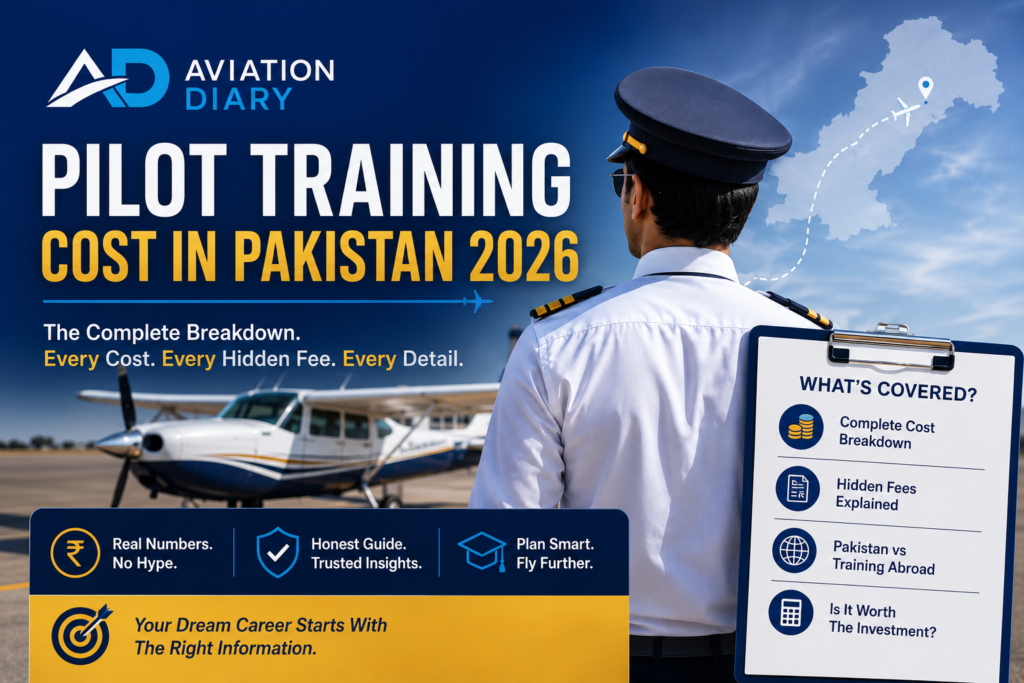

Here is the question that sits in every aspiring pilot’s mind long before they ever set foot in a flying school.
“How much is the pilot training cost in Pakistan?”
And here is the honest answer that most flying academies, aviation websites, and YouTube channels in Pakistan avoid giving you: a lot more than the brochure says.
This is AviationDiary’s most requested article. We have covered [how to become a pilot in Pakistan] and we have covered [pilot salary in Pakistan 2026]. But the cost question — the real, complete, nothing-hidden number — deserves its own dedicated, honest treatment.
So here it is. Every rupee. Every hidden fee. Every cost that flying schools mention in small print or not at all. And at the end, the calculation that tells you whether the investment actually makes financial sense.
Why Pilot Training Costs in Pakistan Are Hard to Pin Down
Before we get into numbers, you need to understand why there is no single clean answer to “How much does pilot training cost in Pakistan?”
Flying hour rates change with fuel prices. Aviation fuel (AVGAS) is priced in line with global oil markets and Pakistan’s rupee exchange rate. When fuel prices spike — as they did dramatically in 2022–2023 — flying hour rates increase immediately. Schools publish estimates but the final cost depends on what fuel costs when you are actually flying.
Hours flown vary by student. PCAA sets minimum hour requirements — 40 hours for PPL, 200 total for CPL. But these are minimums. Many students take more hours to meet the required standard. Every extra hour costs money. A student who needs 250 hours instead of 200 pays significantly more than the course estimate.
Integrated vs modular changes the structure. An integrated course (all training done in one continuous sequence) has a different fee structure from a modular course (done in separate stages). Modular can be cheaper per stage but often takes longer, and time has its own cost.
Hidden fees exist everywhere. Medical fees, exam fees, licensing fees, radio licence fees, headset and equipment costs, ground school books — these are almost never included in the headline course fee. We will list every single one below.
With that context established, let us get into the actual numbers.
Pilot Training Cost in Pakistan 2026 — The Complete Stage-by-Stage Breakdown
Stage 1: PCAA Class 1 Medical Certificate
This is where every pilot’s career begins — and it is the one cost most people forget to include in their budget.
The PCAA Civil Aviation Medical Board (CAMB) conducts the Class 1 medical examination required for CPL training. This covers vision, hearing, cardiovascular, neurological, ENT, and general physical assessments.
| Medical Item | Estimated Cost (PKR) |
|---|---|
| Initial Class 1 Medical Exam | Rs 15,000 – Rs 30,000 |
| Additional tests if required | Rs 5,000 – Rs 20,000 |
| Annual renewal (once licensed) | Rs 10,000 – Rs 20,000 |
The critical advice: Do this before spending a single rupee on flying training. If a medical condition disqualifies you — and some do — you need to know before investing millions in training. No medical clearance means no CPL. It is that simple and that non-negotiable.
Stage 2: Student Pilot License (SPL)
The SPL is your entry point into official flight training. It is obtained through your flying school upon enrolment and allows you to begin training with an instructor.
| Item | Estimated Cost (PKR) |
|---|---|
| PCAA SPL Application Fee | Rs 5,000 – Rs 10,000 |
| FRTOL (Flight Radio Telephony Operators Licence) | Rs 5,000 – Rs 8,000 |
The SPL itself is relatively inexpensive. The real costs begin with actual flight training.
Stage 3: Private Pilot Licence (PPL) Training
The PPL is where your money starts flowing seriously. This is where you learn to actually fly — and it is the foundation upon which everything else is built.
PCAA Minimum Requirements:
- 40 total flight hours
- 7 PCAA written ground examinations
- PPL skill test with a PCAA examiner
PPL Costs at Major Pakistani Flying Schools:
| School | Ground School + PPL Training Fee |
|---|---|
| Karachi Aero Club (Batch/Integrated) | Rs 885,897 (membership + ground school + student kit — flying hours additional) |
| Karachi Aero Club (Individual Instruction) | Rs 999,484 (includes ground school, books, 40 hours flying) |
| Karachi Aero Club (Modular PPL) | Rs 355,000 (ground school only — flying hours billed separately) |
| Air Eagle Aviation Academy (Lahore) | Contact directly — rates updated per fuel price |
| Airborne Aviation (Lahore/Walton) | Contact directly — rates updated per fuel price |
| Rawalpindi Flying Club | Contact directly — government-linked rates differ from private clubs’. |
Industry Average PPL Total Cost: Rs 1,500,000 – Rs 2,500,000
This range reflects the difference between students who complete PPL in minimum hours (40) versus those who require extra hours and between schools with different aircraft types and hourly rates.
The honest truth about PPL hours: Very few students complete PPL in exactly 40 hours. Weather cancellations, scheduling gaps, and the learning curve mean most students fly 45–55 hours before reaching PPL standard. Budget for 50 hours minimum.
Stage 4: Commercial Pilot Licence (CPL) + Instrument Rating (IR)
This is the biggest cost. The CPL is what qualifies you to be paid to fly, and the IR is what qualifies you to fly in cloud and poor visibility — both are mandatory for airline employment.
PCAA Minimum Requirements:
- 200 total flight hours (150 additional hours after PPL in modular training)
- Multi-engine aircraft training
- 6 PCAA written ground examinations (advanced level)
- CPL skill test + IR skill test with PCAA examiner
What the Karachi Aero Club Charges (2026 Published Rates):
The Karachi Aero Club — Pakistan’s oldest and most established flying institution — is the most transparent about fees. Their published 2026 data shows:
- Professional Pilot Course (PPL + CPL + IR): Rs 3,451,000 for 190 hours of flight training, including ground school, books and materials
- This does NOT include CAA medical fees, CAA examination fees, or licensing fees
- Rates are inclusive of 3% Sindh Sales Tax on ground school and club fees as of January 15, 2026
- Flying rates are based on CAA-approved authorization book hours and subject to fuel price variation
Industry-Wide CPL + IR Cost Range:
| Training Component | Estimated Cost (PKR) |
|---|---|
| CPL Ground School | Rs 200,000 – Rs 400,000 |
| CPL Flight Training (150 hours post-PPL) | Rs 2,500,000 – Rs 4,000,000 |
| Multi-Engine Rating Training | Rs 400,000 – Rs 800,000 |
| Instrument Rating (IR) | Rs 500,000 – Rs 1,000,000 |
| CPL + IR Total Range | Rs 3,500,000 – Rs 6,200,000 |
Stage 5: PCAA Examinations and Licensing Fees
This is one of the most consistently underestimated costs in pilot training budgeting. Every exam costs money. Every licence costs money. Every rating costs money.
| Item | Estimated Cost (PKR) |
|---|---|
| PPL Ground Exams (7 subjects) | Rs 20,000 – Rs 40,000 |
| CPL Ground Exams (6 subjects) | Rs 25,000 – Rs 45,000 |
| PPL Skill Test (flight test fee) | Rs 15,000 – Rs 25,000 |
| CPL Skill Test (flight test fee) | Rs 20,000 – Rs 35,000 |
| IR Skill Test (flight test fee) | Rs 15,000 – Rs 30,000 |
| PCAA CPL licence issuance | Rs 15,000 – Rs 30,000 |
| FRTOL licence | Rs 5,000 – Rs 10,000 |
| Total Exam + Licensing Fees | Rs 115,000 – Rs 215,000 |
The retake trap: If you fail a ground exam or skill test, you pay again. Budget for at least one retake per subject in your financial plan. It is not pessimism — it is realistic planning.
The Hidden Costs Nobody Talks About
This section is what separates AviationDiary from every other aviation website in Pakistan. Here are the costs that flying schools almost never mention upfront:
Aviation Headset: A quality aviation headset is not optional — it is required for flight training. Decent entry-level options start at Rs 30,000–60,000. Professional headsets (David Clark, Bose A20) cost Rs 150,000–400,000. Budget Rs 40,000–80,000 for a reliable training headset.
Navigation Equipment: Kneeboard, flight computer (E6B), plotters, and charts. Budget: Rs 15,000–25,000.
Ground School Books and Study Materials: Even when included in course fees, supplementary books, online resources, and practice exam subscriptions add up. Budget Rs 20,000–50,000.
Living Costs During Training: If you are training away from home – in Karachi, Lahore, or Islamabad – rent, food, and transport for 18–24 months are significant additional costs. Budget Rs 30,000–80,000 per month depending on the city and lifestyle.
Training Delays and Gaps: Weather cancellations, aircraft maintenance, and scheduling gaps extend training timelines. Extended timelines mean extended living costs. Build a buffer of 3–6 months into your financial plan.
Medical Renewals: Your Class 1 medical must be renewed annually. Budget Rs 10,000–20,000 per year.
Type Rating (Post-CPL): This is the big one that catches newly licensed pilots off guard. Before an airline can hire you to fly a specific aircraft type (A320, ATR, or B737), you need a type rating on that aircraft. Type ratings are done on full-flight simulators and are extremely expensive:
| Aircraft Type Rating | Estimated Cost |
|---|---|
| ATR 42/72 Type Rating | Rs 2,500,000 – Rs 4,000,000 |
| Airbus A320 Type Rating | Rs 4,000,000 – Rs 7,000,000 |
The good news: Most Pakistani airlines fund the type rating for cadet pilots they hire – it is bonded to a service contract. PIA, Airblue, and Fly Jinnah typically fund this and recover the cost through a 2–3-year service bond. But if you are self-funding a type rating to improve your employability, the cost is enormous.
The Complete Pilot Training Cost in Pakistan — Total Summary
Here is the full picture, consolidated:
| Cost Item | Low Estimate (PKR) | High Estimate (PKR) |
|---|---|---|
| Class 1 Medical | Rs 15,000 | Rs 50,000 |
| SPL + FRTOL | Rs 10,000 | Rs 18,000 |
| PPL Training (40–55 hours) | Rs 1,500,000 | Rs 2,500,000 |
| CPL Training (150+ hours) | Rs 2,500,000 | Rs 4,000,000 |
| Multi-Engine Rating | Rs 400,000 | Rs 800,000 |
| Instrument Rating (IR) | Rs 500,000 | Rs 1,000,000 |
| PCAA Exams + Licensing | Rs 115,000 | Rs 215,000 |
| Equipment (headset, books, etc.) | Rs 75,000 | Rs 155,000 |
| Living costs (18–24 months) | Rs 540,000 | Rs 1,920,000 |
| TOTAL | Rs 5,655,000 | Rs 10,658,000 |
The honest range: Rs 5.5 million to Rs 10.5 million
The Rs 5–7 million figure commonly quoted in Pakistan represents the training fees at minimum hours alone. Once you add living costs, equipment, medical renewals, and exam retakes – the realistic total for most students lands between Rs 7 and 10 million.
Pilot Training Cost in Pakistan vs Training Abroad
This is a question we receive constantly on AviationDiary, and it deserves an honest answer.
Many Pakistani students consider training abroad — particularly in the Philippines, Malaysia, or the UK — to reduce costs or improve the quality of training. Here is the comparison:
| Country | Estimated Total CPL Cost | PCAA Conversion Required? |
|---|---|---|
| Pakistan | Rs 5.5M – Rs 10.5M | No |
| Philippines | ~Rs 14M – Rs 20M (USD 50,000–70,000) | Yes |
| Malaysia | ~Rs 16M – Rs 22M | Yes |
| UK | ~Rs 30M – Rs 45M | Yes |
| USA | ~Rs 25M – Rs 40M | Yes |
The conclusion: Training in Pakistan is significantly cheaper than training abroad in pure cost terms. However, there are scenarios where training abroad makes sense:
Train abroad if:
- Your local flying school has poor aircraft availability or long scheduling delays
- You want a dual licence (foreign + PCAA conversion) to maximise future employment options
- You have family support or scholarship funding that covers the higher cost
Stay in Pakistan if:
- Cost is the primary constraint — Pakistan training is 2–3x cheaper than abroad
- You plan to fly for Pakistani airlines only — PCAA licence is all you need
- You want to be home during the 18–24 months of training
The conversion reality: If you train abroad, you must convert your foreign CPL to a PCAA licence before flying for any Pakistani airline. The conversion process involves passing PCAA ground examinations, a skill test, and medical validation. Budget Rs 200,000–400,000 for conversion costs on top of your foreign training cost.
How to Finance Pilot Training in Pakistan
This is the most practical question. Rs 5.5–10 million is a substantial sum. Here is how Pakistani families and students typically finance it:
Family Funding: The most common route. Many Pakistani pilot training students are financially supported by their families — parents, extended family, or family businesses. If this is your path, be transparent with your family about the realistic total cost including hidden fees.
Bank Education Loans Several Pakistani banks offer education loans for professional training programmes. Requirements typically include:
- Enrolment letter from a PCAA-approved flying school
- Guarantor or collateral
- Proof of family income
Interest rates on PKR loans are significant — factor the total repayment cost into your ROI calculation.
Airline Cadet Bonds: PIA and Airblue have historically run cadet programmes where the airline funds a portion of training (particularly type rating) in exchange for a service bond — typically 2–5 years of employment post-training. Watch airline career portals for these programmes.
UMT Degree Programme (Islamabad) The University of Management and Technology offers a BS Professional Flight Technology — a 4-year undergraduate degree with embedded pilot licence training. The 4-year tuition fee is Rs 1,490,000 plus flying costs at Rs 48,000 per flying hour. This route combines a university degree with pilot licensing, which some airlines value in applications.
Phased Self-Funding (Modular) The modular training route allows students to complete PPL, then work and save, then complete CPL in stages. It takes longer but allows self-funding without a large upfront lump sum. The trade-off is a longer total timeline to licence completion.
The ROI Calculation — Is It Worth It?
Let us do the honest maths that every aspiring Pakistani pilot should run before committing.
Investment: Rs 7,000,000 (mid-range realistic total) Starting salary as Junior First Officer: Rs 250,000/month Time to recover training investment at starting salary: approximately 28 months (2.3 years) — assuming you spend nothing and save everything, which of course you cannot
More realistic payback calculation:
- Monthly salary: Rs 250,000
- Monthly living expenses: Rs 80,000
- Monthly net savings: Rs 170,000
- Months to recover Rs 7,000,000: approximately 41 months (3.4 years)
By the time you reach Senior First Officer (years 5–8), your monthly package is Rs 600,000–900,000. By Captain (years 10–15), Rs 1,500,000–2,500,000.
Over a 30-year career, a Pakistani commercial pilot’s total earnings comfortably reach Rs 200–400 million. Against an initial investment of Rs 7–10 million, the return on investment is extraordinary — provided you make it to Captain level.
The caveat: not every pilot who starts training makes it to Captain. Medical disqualification, training failures, airline hiring slowdowns, and personal circumstances all intervene. The ROI is excellent for those who complete the journey. It is a zero return for those who do not.
For context on what that Captain salary looks like in practice, read our detailed breakdown in [Pilot Salary in Pakistan 2026] on AviationDiary.
7 Brutal Truths About Pilot Training Cost in Pakistan
Truth 1: The brochure price is never the real price. Every flying school’s headline fee excludes something — usually medical fees, exam fees, and living costs. The true cost is always higher than advertised.
Truth 2: Extra flying hours are almost inevitable. PCAA minimums are floors, not guarantees. Budget for 20–30% more hours than the minimum across your training.
Truth 3: Fuel prices can change your budget mid-training. Aviation fuel in Pakistan is priced in dollars and converted to rupees. A rupee devaluation or oil price spike mid-training increases your hourly flying rate with no warning.
Truth 4: The type rating is not included in your CPL cost. Newly licensed pilots are often surprised to discover that a CPL alone is not enough to get hired. Airlines need you on their specific aircraft type — which costs Rs 2.5–7 million extra unless the airline funds it.
Truth 5: Training delays extend living costs significantly. A training timeline that stretches from 18 months to 24 months due to weather, aircraft availability, or personal gaps adds 6 months of living expenses to your budget. For a student in Karachi, that is Rs 300,000–500,000 extra.
Truth 6: Failing exams and skill tests costs money. Every retake – ground exam or flight test – incurs additional fees. Strong ground school preparation is not just academically important; it is financially important.
Truth 7: Training abroad is almost always more expensive, not less. Despite what some advisors suggest, training in the Philippines or Malaysia costs 2–3x more than training in Pakistan once you include travel, accommodation, living costs abroad, and PCAA conversion fees. The advantage of foreign training is a potentially higher-quality flying environment, not a lower cost.
Which Flying School Offers the Best Value in Pakistan?
This is subjective and depends on your location, learning style, and priorities. Here is our honest assessment:
For value and track record: Karachi Aero Club — the oldest institution, published transparent fees, consistent pass rates, established network with Pakistani airlines.
For Lahore-based students: Air Eagle (Shaheen Foundation) and Airborne Aviation at Walton Airport both offer solid training environments without requiring relocation to Karachi.
For Islamabad-based students: Rawalpindi Flying Club is the natural choice, with government backing and a track record of producing pilots for PIA and other carriers.
For flexibility: Modular programmes at any PCAA-approved school allow you to pace your training around work or study commitments.
Whatever school you choose, visit in person before enrolling. Speak to current students. Ask to see the aircraft. Check their published exam pass rates. A school that cannot answer these questions directly is a school to avoid.
For the complete step-by-step guide on the journey from zero to CPL—including how to choose the right flying school—read our post on [How to Become a Pilot in Pakistan 2026](LINK TO HOW TO BECOME A PILOT POST) on AviationDiary.
Frequently Asked Questions: Pilot Training Cost in Pakistan
How much does it cost to become a pilot in Pakistan in 2026? The realistic total — including PPL, CPL, IR, medical, exams, equipment, and living costs — ranges from Rs 5.5 million to Rs 10.5 million depending on the school, hours flown, and whether you train in your home city. Budget Rs 7–8 million as a realistic mid-range figure.
Is pilot training in Pakistan cheaper than abroad? Yes — significantly. Training in Pakistan costs Rs 5.5–10.5 million total. The same training in the Philippines costs Rs 14–20 million and in the UK or USA Rs 25–45 million. Training abroad also requires PCAA licence conversion at additional cost.
What is the cheapest flying school in Pakistan for CPL training? Cost varies by location and fuel prices rather than school prestige. Government-linked institutions like may have subsidised rates for some programmes. Contact multiple schools directly for current quotations as rates change with fuel prices.
Does the pilot training cost include the type rating? No. Type ratings (A320, ATR, B737) are separate from CPL training and cost Rs 2.5–7 million. Most Pakistani airlines fund the type rating for cadet pilots under a service bond arrangement.
Can I get a loan for pilot training in Pakistan? Yes. Several Pakistani banks offer education loans for PCAA-approved pilot training programmes. Requirements include enrolment confirmation, a guarantor, and income proof. Factor total loan repayment (with interest) into your ROI calculation.
How long does pilot training take in Pakistan? Minimum 18 months for an integrated CPL/IR programme. Realistically 24–30 months for most students accounting for weather delays, scheduling gaps, and exam preparation time.
What happens if I fail the PCAA medical after starting training? This is the hardest scenario. If a medical condition is discovered that disqualifies you for a Class 1 certificate, you cannot complete CPL training. Any fees paid are generally non-refundable. This is why getting the medical done first — before any training fees are paid — is so strongly advised.
Final Thoughts
The pilot training cost in Pakistan is significant — there is no softening that reality. Rs 7–10 million is a life-changing financial commitment that deserves serious, clear-eyed planning.
But the return on that investment, for those who complete the journey and build a full airline career, is also extraordinary. A Pakistani airline captain earning Rs 1.5–2.5 million per month, flying to London, Dubai, or New York, with free travel for the family — that is a career and a life that most professions simply cannot offer.
Go in with realistic numbers. Budget conservatively. Get your medical done first. Choose your school carefully. And read everything on AviationDiary.com before making any decisions — because honest information is the most valuable thing an aspiring pilot can have.
Fly safe — and plan smart.

Your Window to the World Above!