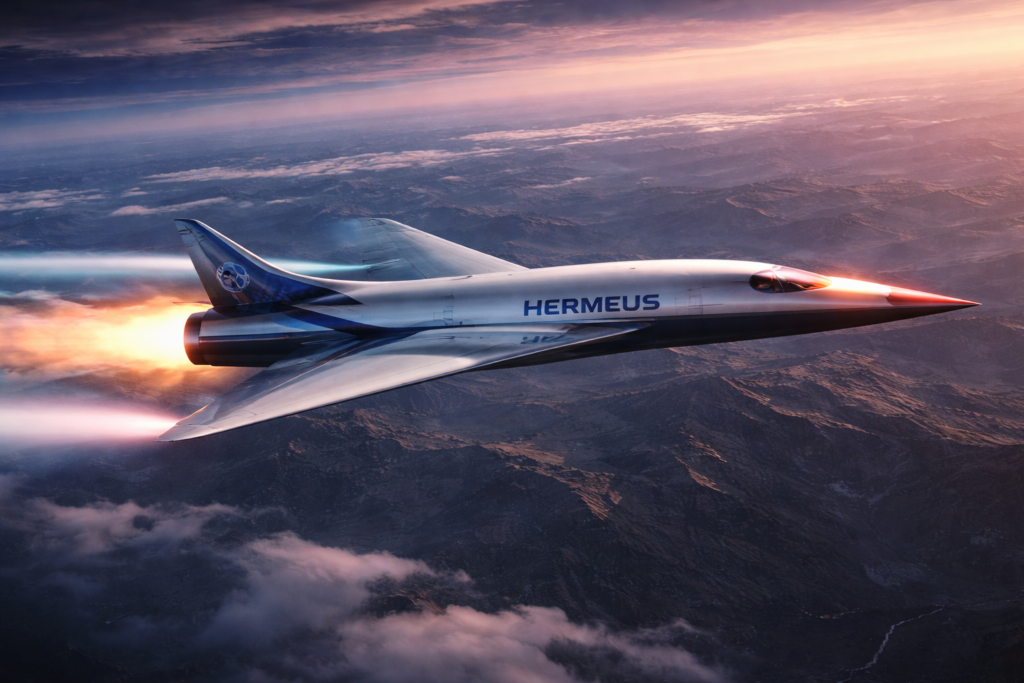

Hermeus Quarterhorse: The Race to Mach 5 and the Hypersonic Commercial Aviation Comeback
The last time the world experienced commercial flight faster than the speed of sound, Concorde was still slicing across the Atlantic. That era ended in 2003, leaving the aviation industry stuck at roughly the same cruising speed ever since.
For more than two decades, hypersonic passenger travel has remained largely theoretical — discussed in engineering papers, startup pitch decks, and ambitious aerospace concepts.
But that may finally be changing.
In March 2026, Atlanta-based aerospace startup Hermeus completed the maiden flight of its Quarterhorse Mk 2.1 at Spaceport America in New Mexico. The unmanned aircraft flew less than a year after its predecessor first took to the skies, demonstrating one of the fastest development cycles in modern aerospace.
More importantly, the company is now pushing toward a bold milestone: breaking the Mach 5 barrier within this decade.
Hypersonic commercial aviation is no longer just a concept. The aircraft are already flying.
What Exactly Is Hermeus — And Why Should Aviation Care?
Hermeus was founded in 2018 by AJ Piplica alongside a group of engineers with backgrounds at SpaceX, Blue Origin, and Generation Orbit.
Their mission is ambitious: build the world’s fastest reusable aircraft — not a rocket, not a spaceplane, but a jet-powered aircraft capable of taking off and landing like a conventional airplane while reaching hypersonic speeds.
The company’s long-term roadmap revolves around two flagship programs:
Darkhorse
An uncrewed hypersonic military drone designed for the U.S. Department of Defense, focused on rapid reconnaissance and testing applications.
Halcyon
A 20-passenger hypersonic commercial aircraft capable of flying from New York to London in just 90 minutes at Mach 5.
For context:
- Current New York–London flights take around 7 hours
- Concorde once completed the route in under 4 hours
- Halcyon aims to do it in just 90 minutes
That would mean cruising at roughly 3,800 miles per hour.
The Quarterhorse Program: Four Aircraft, One Giant Leap
Before building a commercial aircraft like Halcyon, Hermeus must first prove its core technologies. That is where the Quarterhorse test program comes in.
Quarterhorse is an iterative series of four unmanned aircraft, each progressively faster and more capable than the previous one.
Mk 0 — The Iron Bird
The Quarterhorse Mk 0 served as a ground-based prototype rather than a flying aircraft.
Its role was to validate fundamental systems including:
- Remote command operations
- Taxi capability
- Subsystem integration
- Baseline structural architecture
The prototype successfully completed testing in 2023, establishing the engineering foundation for future vehicles.
Mk 1 — First Flight
The Quarterhorse Mk 1 took flight on 21 May 2025 from Edwards Air Force Base — the historic location where Chuck Yeager first broke the sound barrier in 1947.
Although the aircraft remained subsonic, speed was not the primary objective. Instead, Mk 1 focused on validating:
- High-speed takeoff and landing performance
- Aerodynamic stability
- Fuel delivery systems
- Hydraulic controls
- Flight software
The test flight proved Hermeus’s rapid iterative development strategy could work.
“We’ve proven the viability of our iterative development approach,” CEO AJ Piplica said after the flight. “But this is just the start.”
Mk 2.1 — The Supersonic Leap
The Quarterhorse Mk 2.1 completed its first flight on 2 March 2026 at Spaceport America, New Mexico — less than 10 months after Mk 1 first flew.
That pace alone is remarkable in the aerospace industry, where development cycles often span years or even decades.
Compared to its predecessor, the Mk 2.1 is significantly more advanced:
- Nearly three times larger
- Approximately four times heavier
- Powered by a Pratt & Whitney F100 turbofan
The F100 engine is widely known for powering fighter jets such as the F-15 and F-16.
The aircraft also features:
- A delta-wing configuration
- A variable air intake integrated into the nose cone
- A proprietary air pre-cooling system designed to reduce inlet temperatures at extreme speeds
The Mk 2 series will include three iterations — 2.1, 2.2, and 2.3 — each pushing further into the supersonic flight regime.
The upcoming Mk 2.2 is already under development and could become the fastest unmanned aircraft ever built.
The Chimera Engine: Unlocking Mach 5
Perhaps the most critical technology behind the entire Hermeus program is its Chimera propulsion system.
Chimera is a Turbine-Based Combined Cycle (TBCC) engine — effectively combining two propulsion systems into one.
At lower speeds, Chimera operates as a traditional turbojet engine, similar to those used in modern commercial aircraft.
As the aircraft accelerates beyond Mach 2 or Mach 3, the system transitions into ramjet mode. Instead of compressing air using turbine blades, it relies on the natural compression created by high-speed airflow.
This allows the engine to continue producing thrust efficiently at hypersonic speeds approaching Mach 5.
The challenge is immense. Switching between two entirely different combustion modes while managing extreme temperatures — often exceeding 1,000°C — represents one of the most complex engineering problems in aerospace.
Hermeus claims it has already successfully demonstrated this turbojet-to-ramjet transition during testing.
The upcoming Quarterhorse Mk 3 will be the first aircraft to integrate the full Chimera II propulsion system.
The Pentagon’s Bet on Hypersonic Technology
Hermeus has pursued a strategic funding model by positioning its early aircraft as military test platforms.
This approach provides the U.S. Department of Defense with something it urgently needs: rapid and affordable hypersonic flight testing capability.
Key milestones include:
- 2020: $1.5 million contract from the U.S. Air Force Research Laboratory
- 2021: Expanded $60 million joint funding agreement
- 2022: $100 million Series B investment, led by Sam Altman
Investors also include:
- Founders Fund
- In-Q-Tel
- Khosla Ventures
Additionally, the Defense Innovation Unit selected Hermeus for its Hypersonic and High-Cadence Airborne Testing (HyCAT) program.
The company has also begun construction of the HEAT (Hermeus Engine and Airframe Test) facility at Cecil Airport in Jacksonville, Florida, scheduled to begin operations in 2026.
This dual-track strategy mirrors the SpaceX model: government contracts fund technological breakthroughs that eventually power commercial platforms.
Halcyon: A 90-Minute Transatlantic Flight
Ultimately, all of this development leads to Halcyon, the commercial hypersonic aircraft Hermeus hopes will redefine global travel.
The aircraft is expected to:
- Carry approximately 20 passengers
- Fly at Mach 5
- Serve 125 trans-oceanic routes
Ticket prices are expected to range between $3,000 and $5,000 for a one-way transatlantic flight — comparable to current premium business-class fares.
Hermeus estimates that just the New York–London route alone could carry 500,000 passengers annually, saving millions of travel hours.
Across global markets, the company believes hypersonic travel could generate up to $4 trillion in annual economic impact.
Competition in the Hypersonic Race
Hermeus is not alone in pursuing high-speed aviation.
Stratolaunch successfully conducted the first hypersonic flight of its Talon-A vehicle in 2024. However, its system requires air-launch from a massive carrier aircraft, making commercial adaptation more complex.
Meanwhile, Boom Supersonic is developing the Overture airliner, targeting Mach 1.7 speeds.
While impressive, that is still far slower than Hermeus’s Mach 5 ambition.
Meanwhile, China has reportedly tested hypersonic vehicles capable of reaching Mach 6.5, signaling an intensifying global race for high-speed aviation dominance.
The Challenges Ahead
Despite the progress, enormous challenges remain.
At Mach 5, aerodynamic heating becomes extreme. Leading edges and nose sections of aircraft can reach temperatures exceeding 1,000°C, requiring advanced materials capable of surviving repeated hypersonic flights.
Regulation presents another major hurdle. The FAA has never certified a hypersonic commercial aircraft, meaning new certification frameworks will need to be developed.
Economic viability is also uncertain. Hypersonic aircraft consume significantly more fuel than conventional airliners, raising operating costs.
Aviation analyst Richard Aboulafia of the Teal Group has suggested the odds of hypersonic commercial travel becoming widespread by the late 2030s may be as low as 1%.
Even Hermeus CEO AJ Piplica has acknowledged that failure remains a real possibility.
The Decade That Will Define High-Speed Aviation
Regardless of the outcome, Hermeus is already reshaping how aerospace programs are developed.
The company’s rapid iteration model, combined with hardware-first engineering, is dramatically compressing development timelines that once took decades.
The Quarterhorse Mk 2 series is now underway, the HEAT test facility opens in 2026, and Quarterhorse Mk 3 — designed to push speeds beyond Mach 3.3 — is already in development.
Beyond that lie Darkhorse and eventually Halcyon.
Commercial aviation has remained stuck around Mach 0.85 since Concorde retired. For an industry built on innovation, that stagnation has always felt temporary.
The race to Mach 5 is no longer theoretical.
It is already underway — high above the skies of New Mexico.
And if Hermeus succeeds, the 90-minute transatlantic flight may soon become one of the most transformative breakthroughs in modern aviation.