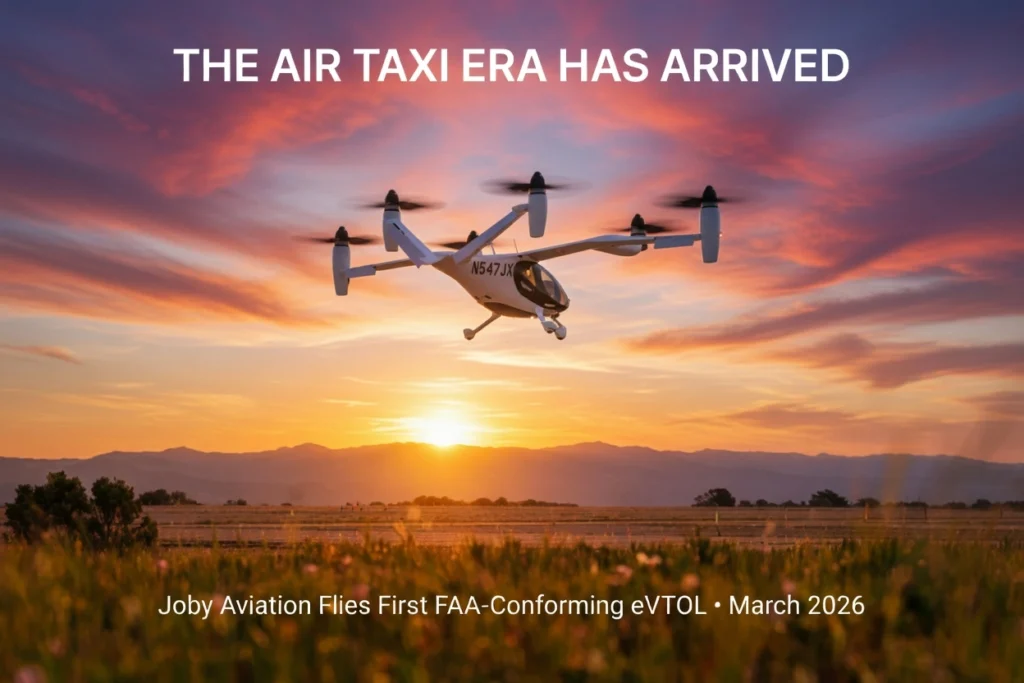

The Era of Air Taxis Has Arrived: Joby Aviation Flies Its First FAA-Conforming eVTOL
For years, the electric air taxi has been aviation’s most frustrating broken promise. Every few months brought another funding round, another polished CGI render, and another CEO on stage promising service “by 2025.” Then 2025 came and went. Yet on 11 March 2026, something genuinely different happened.
Joby Aviation took to the skies with N547JX — its first FAA-conforming aircraft — conducting initial flight tests from the company’s facility in Marina, California. This was no prototype. No technology demonstrator. This was a production-representative aircraft built to the exact design specifications submitted for FAA type certification, signed off by FAA Designated Engineering Representatives (DERs) and Designated Airworthiness Representatives (DARs).
In short: this is the aircraft Joby intends to certify and fly commercially. And it is already airborne.
I have followed the eVTOL sector since the early 2020s with a healthy mix of excitement and skepticism. Today, I am no longer skeptical. What Joby has achieved in the past twelve months represents the most credible, tangible progress the industry has ever seen toward commercial air taxi operations.
What “FAA-Conforming” Actually Means — And Why It Matters
In aviation certification, there is a world of difference between a prototype and a conforming aircraft.
- A prototype proves a concept.
- An FAA-conforming aircraft is built precisely to the design data that will be submitted for type certification — the formal FAA seal that the aircraft is safe to carry paying passengers in commercial service.
N547JX was first powered on in November 2025. Every major component — airframe, propulsion system, avionics, and structure — was manufactured to designs approved by FAA DERs. Before its maiden flight, FAA DARs signed off on the aircraft’s airworthiness. This is not Joby simply flying its own hardware under experimental rules. This is hardware that has already passed formal FAA-designated review.
The first flights also mark the beginning of Stage 5 in the FAA’s aircraft-level evaluation — the final phase of the type certification process. Previous stages focused on individual systems and components. Stage 5 evaluates the aircraft as a complete, integrated system. Joby test pilots are now building hours on N547JX to mature the test program and prepare the aircraft for FAA pilots, who are expected to fly “for-credit” Type Inspection Authorization (TIA) flights later in 2026.
Meet the S4: Joby’s Electric Air Taxi
Joby’s S4 is a five-seat (one pilot + four passengers) all-electric vertical takeoff and landing (eVTOL) aircraft featuring six tilting rotors.
- In hover mode, the rotors point upward like a multirotor drone.
- As speed increases, they tilt forward, transitioning the aircraft into efficient fixed-wing cruise at up to 200 mph (322 km/h).
- Target range on a single charge is approximately 100 miles (161 km), including reserves.
- Cruise noise is targeted at around 45 dBA — roughly the level of a quiet conversation — compared to 85–90 dBA for a conventional helicopter at similar distances.
That noise figure is not a side benefit; it is central to Joby’s entire business model. Urban air taxis cannot scale if every departure rattles windows and triggers noise complaints.
The all-electric powertrain delivers zero direct emissions per flight, significantly lower operating costs than jet fuel, and far simpler mechanical maintenance than turbine helicopters. Joby has publicly targeted an operating cost of approximately $3 per passenger mile — a figure that could bring premium commuter travel within reach for a much broader market.
The Numbers Behind the Milestone: 850+ Test Flights in 2025
The headline-grabbing first flight of N547JX is impressive, but the real foundation lies in the relentless flight testing that preceded it.
In 2025 alone, Joby completed more than 850 test flights — a 260% increase over 2024. These were not simple hover tests. Key achievements included:
- The first piloted transition from hover to forward flight in April 2025.
- Public demonstrations at Japan’s Fuji Speedway, the 2025 World Expo in Osaka, the Dubai Airshow, and multiple events in California.
- Deliberate testing of propeller-out scenarios to validate redundancy and fault tolerance — critical for safe operations in dense urban environments.
- Confirmation of the aircraft’s “super-pilot” autonomous capabilities.
By the end of 2025, Joby’s test fleet had accumulated tens of thousands of miles and thousands of test points, building an extraordinary body of real-world data.
Why This Moment Feels Different
After years of hype cycles and repeated delays across the eVTOL industry, Joby’s progress stands out for its discipline and transparency. The company has methodically worked through the FAA’s rigorous certification pathway rather than rushing announcements.
With the first conforming aircraft now flying, FAA “for-credit” testing on the horizon, and supportive regulatory developments such as the White House-backed eVTOL Integration Pilot Program opening doors for early operations in multiple U.S. states, the path to commercial service has never looked clearer.
The air taxi era is no longer coming. It is here — and Joby Aviation has just taken a decisive step forward.
Stay tuned to Aviation Diary for continued coverage as Joby moves through TIA testing and toward the historic day when the first paying passengers board an electric air taxi.
What are your thoughts on the future of urban air mobility? Will eVTOLs truly transform city travel, or remain a premium niche? Share your views in the comments.
Sources include official Joby Aviation announcements and industry reporting from March 2026.