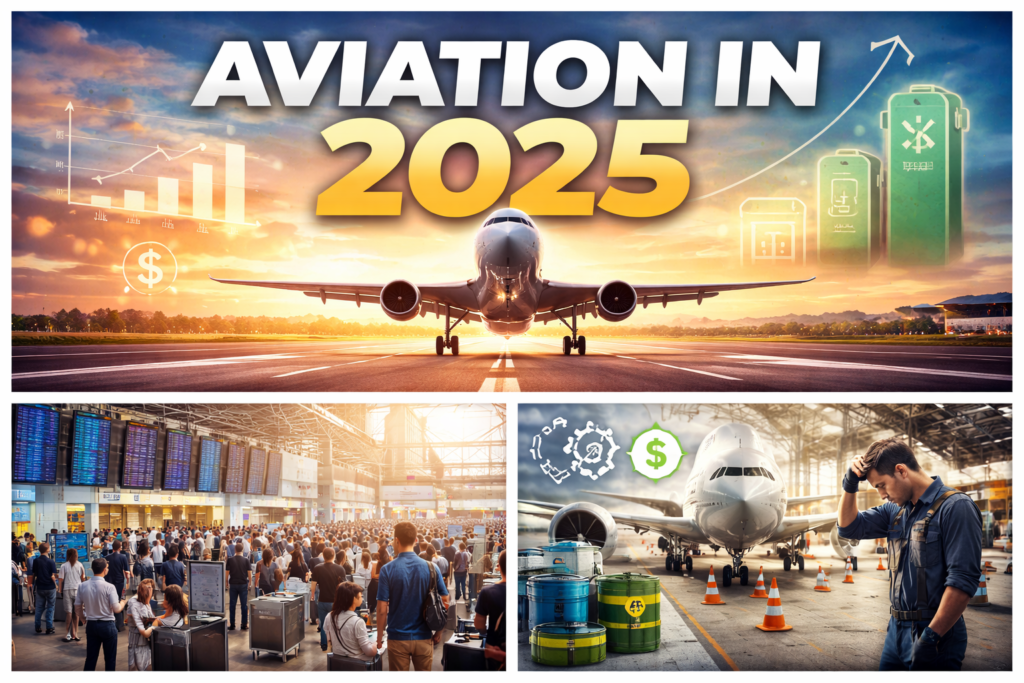

The year 2025 will stand out as a landmark moment in global aviation. For the first time, the airline industry crossed the $1 trillion revenue mark while carrying more than 05 billion passengers worldwide. After years of recovery and recalibration, air travel firmly reclaimed its role as a backbone of the global economy. Yet this success did not come easily. Behind the headline numbers, airlines faced persistent supply constraints, workforce shortages, geopolitical disruptions, and mounting pressure to decarbonize.
For Aviation Diary, 2025 was not just a year of growth it was a test of resilience.
Passenger Demand Reaches Historic Highs
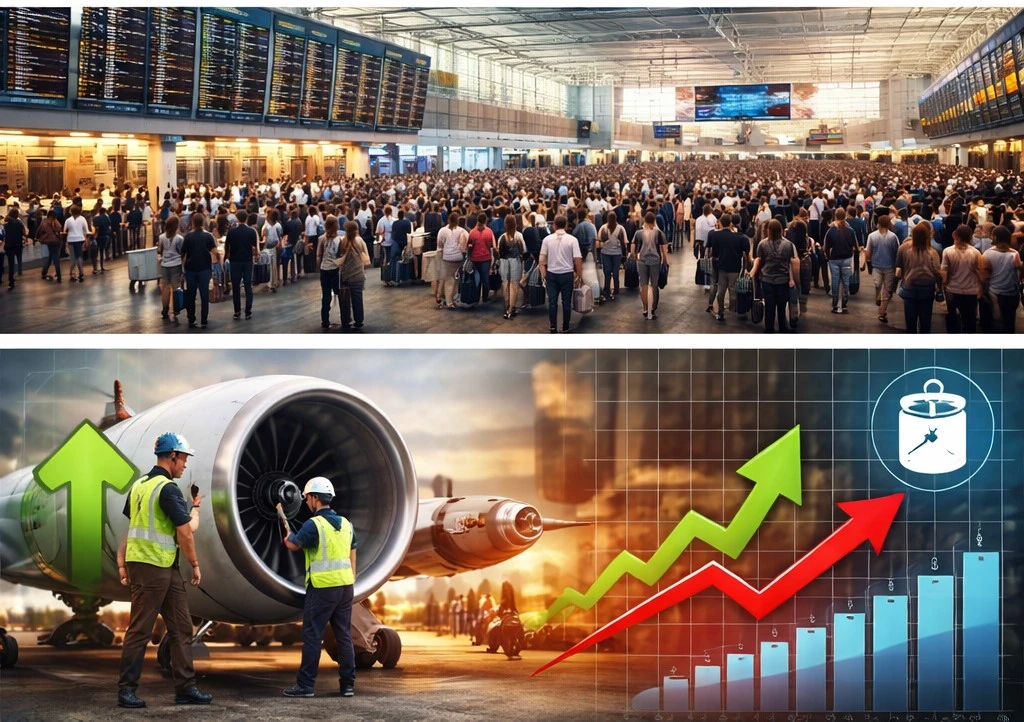
Global passenger traffic surged past 05 billion travelers, a symbolic and operational milestone. Leisure travel continued to dominate demand, fueled by pent-up appetite for international tourism, while business travel showed a meaningful rebound on premium long-haul routes.
Growth was particularly strong in Asia-Pacific and the Middle East, where hub-based carriers capitalized on geography and network depth. Load factors frequently climbed above 85 percent during peak periods, signaling that aircraft were flying fuller than at any point in recent memory.
This resurgence confirmed one thing clearly: despite digital alternatives, the desire to fly remains deeply ingrained in global mobility.
Record Revenues, Fragile Profitability
Financially, the industry reached new heights but margins told a more cautious story. Total airline revenues climbed to approximately $1.008 trillion, while net profits were estimated at around $39.5 billion. That translates into a slim 3.9 percent profit margin, underscoring aviation’s long-standing vulnerability to cost shocks.
A partial tailwind came from fuel markets. Jet fuel prices fell by nearly 13 percent compared to 2024, offering temporary relief. However, rising labor costs, higher maintenance spending, and inefficiencies caused by fleet shortages quickly absorbed much of that benefit.
In simple terms, airlines flew more people than ever but profitability remained a delicate balancing act.
Aircraft Shortages and an Aging Global Fleet
One of the defining challenges of 2025 was the persistent aircraft supply crunch. Ongoing manufacturing delays, engine reliability concerns—particularly within geared turbofan programs and labor disruptions at major OEMs significantly slowed new aircraft deliveries.
As a result:
- The average global fleet age increased to around 15 years
- More than 1,100 relatively young aircraft were grounded worldwide due to maintenance and engine availability issues
- Airlines extended leases, reactivated older jets, and postponed expansion plans
The gap between demand and available capacity became a structural constraint, reshaping network strategies across the industry.
Labor Shortages Behind the Scenes
Beyond aircraft availability, human capital emerged as a critical bottleneck. Airlines, maintenance organizations, and air navigation service providers all struggled to recruit and retain skilled professionals.
Shortages of pilots, engineers, and air traffic controllers pushed wages higher and increased training costs. In some regions, staffing limitations directly affected flight schedules, proving that sustainable growth depends as much on people as on airplanes.
Geopolitics Redraw Global Air Routes
Geopolitical instability continued to influence flight operations throughout 2025. Airspace closures and trade tensions forced airlines to adopt longer routings, increasing fuel burn and flight times.
European carriers remained constrained by limited access to Russian airspace, while Middle Eastern airlines benefited from their strategic geographic positioning between East and West. These shifts subtly altered competitive dynamics and highlighted how politics increasingly shapes commercial aviation.
Safety: A Year of Sobering Reminders
While aviation remains statistically one of the safest modes of transport, 2025 saw several high-profile incidents that drew global attention. Among them was Air India Flight 171, marking the first fatal accident involving a Boeing 787 Dreamliner.
Although long-term safety trends remain positive, these events reinforced the importance of rigorous oversight, continuous training, and uncompromising safety culture in an industry built on public trust.
Sustainability Moves Forward Slowly
Environmental responsibility took center stage in 2025. Sustainable Aviation Fuel (SAF) production doubled, yet it still represented only 0.7 percent of total jet fuel consumption far short of what is needed to meet net-zero targets by 2050.
Global forums, including ICAO’s Aviation Climate Week, reflected growing urgency around decarbonization. The message was clear: progress is real, but scaling sustainable solutions remains the industry’s biggest long-term challenge.
Technology and the Road Ahead
Digital transformation accelerated across airline operations. Artificial intelligence was increasingly used for predictive maintenance, operational planning, and disruption management. At the same time, electric vertical take-off and landing (eVTOL) aircraft moved closer to limited commercial service in select regions, hinting at the future of urban air mobility.
The Big Picture
Seen from altitude, 2025 was a year of strong recovery tempered by structural realities. Passenger confidence returned, revenues broke records, and innovation continued but thin margins, supply constraints, and geopolitical uncertainty kept the industry grounded in caution.
As aviation looks toward 2026, optimism remains measured. Growth is strong, but success will depend on how effectively airlines balance resilience, sustainability, and technological adaptation in an increasingly complex global environment. For Aviation Diary, 2025 was not a finish line it was a clear signal that the next era of aviation will be defined not just by how much the industry grows, but by how wisely it evolves.