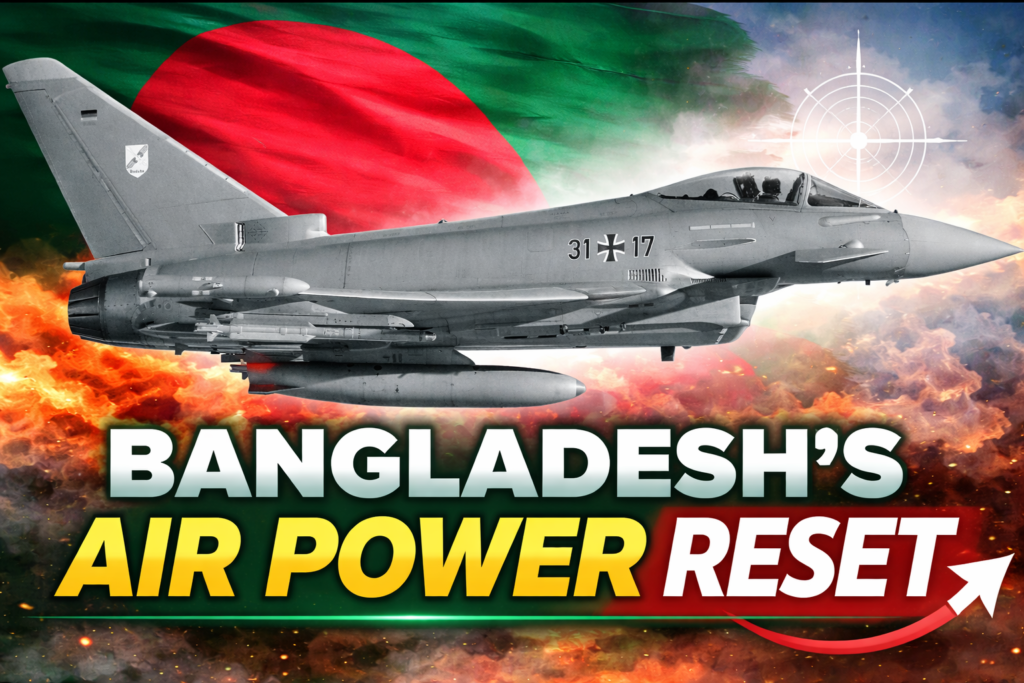

For decades, Bangladesh’s air power posture reflected restraint—built around legacy Soviet- and Chinese-origin platforms designed for territorial defense rather than strategic influence. That era may now be drawing to a close.
Dhaka’s move toward acquiring Eurofighter Typhoon multirole fighters alongside Turkey’s T-129 ATAK attack helicopters represents one of the most consequential airpower transitions in South Asia since the end of the Cold War. This is not simply a fleet refresh. It is a deliberate pivot toward Western-interoperable, network-centric air warfare, signaling how Bangladesh intends to position itself in an increasingly competitive Indo-Pacific security environment.
A Break from the Past
At the heart of this transformation lies Bangladesh’s long-running Forces Goal 2030 modernization framework. Conceived in 2009 and revitalized in recent years, the initiative aims to reshape the country’s armed forces into a balanced, tri-service structure capable of defending national sovereignty, responding rapidly to crises, and contributing meaningfully to international peacekeeping operations.
Within this framework, the Bangladesh Air Force (BAF) has emerged as the service most in need of renewal. Its current combat fleet—dominated by Chengdu F-7 interceptors and aging MiG-29 Fulcrums—faces growing limitations in a battlespace defined by beyond-visual-range combat, electronic warfare resilience, and sensor fusion. Rising maintenance costs, constrained upgrade paths, and spare-parts challenges have only sharpened the urgency.
Without a decisive leap into modern multirole aviation, Bangladesh risks strategic irrelevance in its own airspace.
Enter the Eurofighter Typhoon
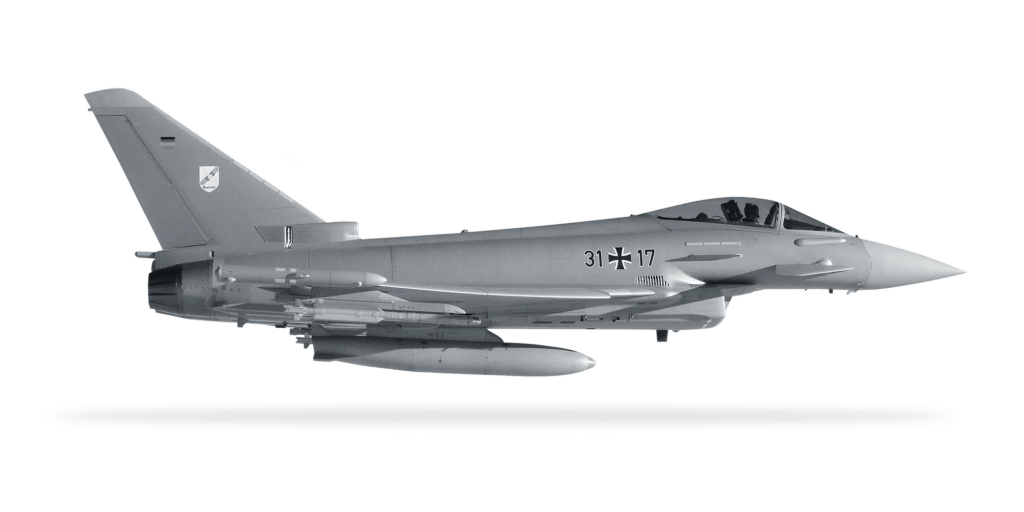
The signing of a Letter of Intent (LoI) on 9 December with Italy’s Leonardo—acting on behalf of the four-nation Eurofighter consortium—marks a pivotal moment. While official numbers remain undisclosed, local and international reporting suggests Bangladesh is evaluating 12 to 16 Typhoons, potentially making it the first Asian operator of the European fighter.
If finalized, this would be Bangladesh’s first major acquisition of a Western-designed combat aircraft—a symbolic and operational departure from decades of procurement patterns.
The Typhoon brings with it far more than raw performance. Designed as a fourth-plus generation air superiority and strike platform, it offers advanced radar, electronic warfare systems, and long-range precision engagement capabilities. More importantly, it is built to operate seamlessly within joint and coalition frameworks, enabling data sharing, networked command and control, and interoperability with allied air forces.
For Bangladesh, this means moving away from platform-centric force planning toward effects-based air operations—where information dominance and integration matter as much as aircraft numbers.
The ATAK Dimension: Completing the Vertical Spectrum
Complementing the Typhoon’s high-end air dominance role is Dhaka’s parallel interest in Turkey’s T-129 ATAK attack helicopters. Optimized for close air support, anti-armor missions, and low-altitude operations, the ATAK fills a long-standing capability gap in the BAF’s rotary-wing force.
Together, the Typhoon–ATAK combination allows Bangladesh to operate across the full vertical spectrum of airpower—from airspace control and maritime strike over the Bay of Bengal to persistent battlefield support in complex coastal, jungle, and border environments.
This layered approach complicates any adversary’s operational calculus. Potential challengers would now have to contend with a survivable, networked air force capable of imposing costs across multiple domains rather than a force limited to point defense.
Strategic Drivers Behind the Shift
Several regional pressures are accelerating Dhaka’s calculus. Recurrent border tensions with Myanmar, the rapid militarization of the Bay of Bengal, and intensifying great-power competition across the Indo-Pacific have all placed a premium on credible air surveillance, rapid response, and deterrence.
Bangladesh’s economic lifelines—its ports, sea lanes, and densely populated coastal zones—are particularly vulnerable without robust air cover. Against this backdrop, the decision to authorize multi-billion-dollar air force acquisitions by the mid-2020s reflects a sober assessment: airpower modernization is no longer optional.
More Than Aircraft
Crucially, Bangladesh’s engagement with the Eurofighter program is not being framed as a simple purchase. Training pipelines, sustainment ecosystems, industrial cooperation, and long-term upgrade pathways are central to the discussion. The Typhoon’s global user base and upgrade roadmap—extending well into the 2060s—offer Dhaka a degree of future-proofing rarely available with legacy platforms.
Equally important is the institutional signal. This shift reflects a maturing air force that understands modern deterrence is built on integration, data dominance, and interoperability, not just flight-hour counts.